Key TakeawaysEffective MLR review management depends on measuring the right process metrics, not just tracking whether materials reached final approval.
Leaders who build measurement discipline into their programs gain more than faster approvals: a defensible, auditable process. |
Most pharma marketing operations leaders can describe their review process as slow. Fewer can articulate where it slows down, by how much, and why. That gap between recognizing a problem and having data to act on it is the core challenge of MLR review management. Without a consistent measurement framework, cycle time conversations stay anecdotal, bottleneck analysis stays reactive, and improvement initiatives stay difficult to justify. The FDA's Office of Prescription Drug Promotion issued more than 200 enforcement letters in 2025 alone. Teams without structured oversight of their promotional review process carry real exposure.
This guide is for MLR operations leaders, review directors, and brand leads who want to move from gut-feel management to data-driven oversight. It covers the KPIs worth tracking, what a well-designed MLR dashboard should surface, how to locate bottlenecks, and where specialized AI fits in. The purpose-built promotional review tooling offers a reference point for how specialized platforms support this kind of work.
What Does Effective MLR Review Management Actually Measure?
A measurement framework for MLR review management separates output metrics from process health metrics. Output metrics tell you what happened. Process health metrics tell you why and where to intervene.
Review Cycle Time
Cycle time is the elapsed time from when an asset enters the queue to final approval. Tracking it at the asset level surfaces which content categories or brand teams run consistently slower. Stage-level breakdowns, separating queue time from active evaluation from revision time, are what make real bottleneck analysis possible. Without that granularity, teams routinely optimize the wrong stage. For background on how each reviewer function shapes the process, the roles of legal reviewers and risk management in MLR is a useful grounding.

Throughput, Rework Rate, and Time in Queue
Throughput measures how many assets a review team clears per period. Paired with capacity data, it reveals load distribution and signals capacity pressure before any reviewer flags a concern. Rework rate counts assets requiring at least one revision after first submission. High rework rates point to upstream preparation issues that, when addressed, typically produce meaningful review cycle time reductions without any change to reviewer workload. Time in queue separates passive wait time from active review time, which is the distinction that makes resource allocation decisions evidence-based rather than speculative.
Together, these metrics are the foundation of process intelligence in pharma marketing operations. They also make the connection between claims library quality and review performance visible: when content creators have access to validated, current claims language, first-pass approval rates improve and the overall review process becomes more predictable.
What Should an MLR Dashboard Surface for Each Stakeholder?
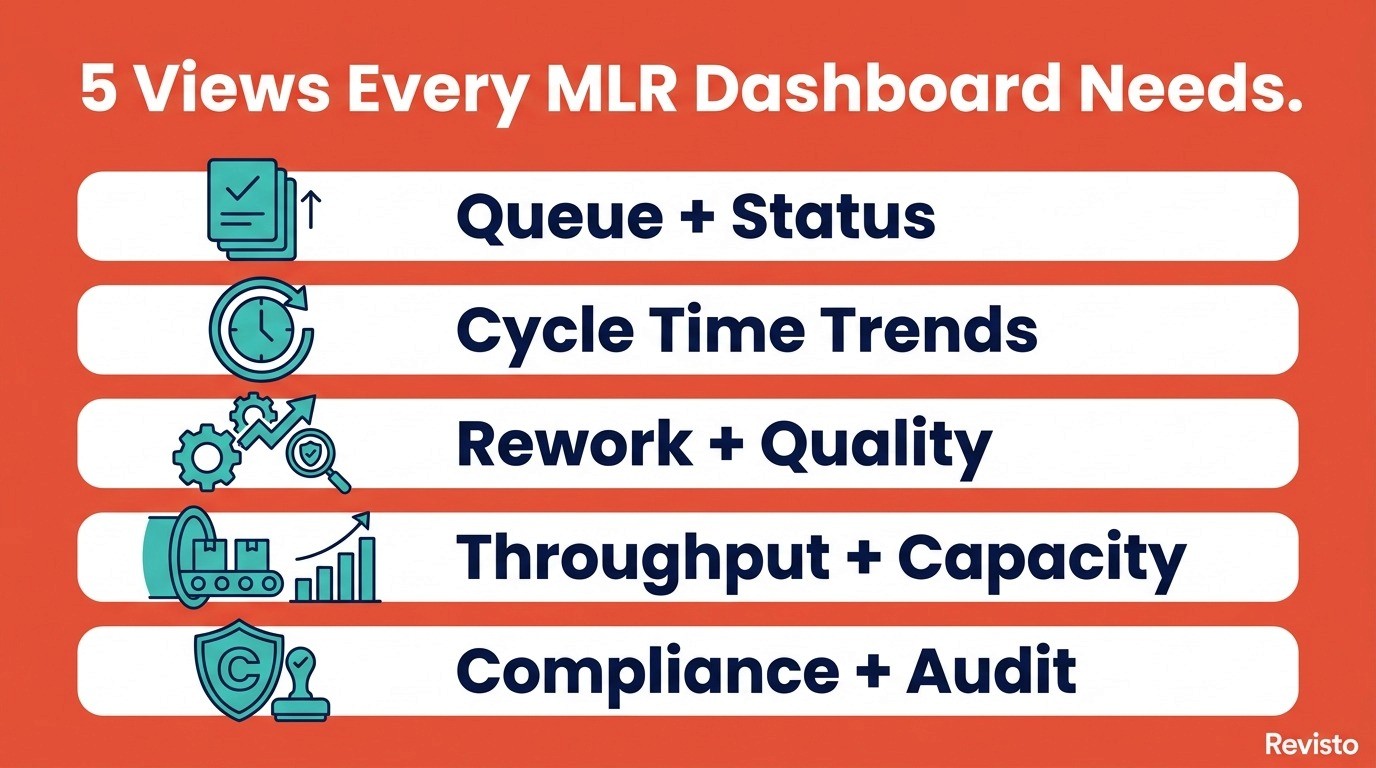
A well-designed dashboard makes the current state of the queue legible to multiple stakeholders at once: MLR operations leads who need process visibility, brand managers who need asset status, and compliance leadership who need portfolio-level trend data.
Dashboard View | Key Data Displayed |
Queue and status view | Assets by stage, days in current stage, assignee, submission date |
Cycle time trend view | Average and median cycle time by month, content type, brand, reviewer role |
Rework and quality view | First-pass approval rate, revision round count, common rejection categories |
Throughput and capacity view | Assets cleared per period, reviewer load, open vs. completed by team |
Compliance and audit view | Approval status, version history, sign-off timestamps, audit trail completeness |
Pharma promotional content is subject to Form 2253 submission requirements, meaning an auditable record of when each asset was approved, by whom, and in what form is a compliance requirement. A dashboard that surfaces this in a structured, exportable format reduces the manual burden of audit preparation. King and Spalding's 2025 FDA enforcement review noted over 200 enforcement actions targeting prescription drug promotion that year, which illustrates why audit-ready documentation functions as a core operational requirement.
How Do You Locate Bottlenecks in a Promotional Review Process?
Three bottleneck patterns appear consistently across pharma marketing operations contexts, and they are rarely the ones leadership expects.
Submission Quality as a Hidden Bottleneck
A significant share of extended review cycle times originates before an asset reaches any reviewer. Incomplete reference packs, unsubstantiated claims, or content drafted without access to pre-approved language force changes to the materials. This looks like a review stage problem, but it is a preparation problem: improving claims library access and submission completeness requirements reduces rework at the source rather than adding reviewer bandwidth that gets absorbed by the same preventable issues.
Sequential Review and Revision Loop Patterns
Many organizations run medical, legal, and regulatory review sequentially, with each function waiting for the prior one to complete. A parallel structure, where all three functions review simultaneously with a reconciliation step at the end, can substantially reduce throughput time for high-volume brands.
Separately, rework cycles compound elapsed time in ways that are visible in aggregate but hard to diagnose without categorized revision data. When revision requests are tracked by type, whether a fair balance gap, an unsubstantiated claim, a labeling inconsistency, or an editorial issue, patterns emerge that point to fixable upstream causes. The financial costs of MLR revisions make the case for why root-cause tracking pays off quickly.

5 KPIs That Define a Mature MLR Review Management Program
These five KPIs follow a progression from foundational to advanced.
First-pass approval rate. The percentage of assets approved without any revision request. This is the most reliable leading indicator of submission quality and preparation rigor. Improving it typically requires better access to validated claims language and clearer pre-submission guidance for content creators.
Stage-level cycle time. The average time at each distinct phase of the review process, tracked separately for queue time and active evaluation time. This is the foundational data input for bottleneck analysis and process redesign decisions.
On-time completion rate. The percentage of review cycles completed within established stage-level turnaround targets. This creates accountability for performance without conflating operational delays with reviewer judgment calls, and reveals whether targets are calibrated to actual team capacity.
Revision category distribution. The breakdown of revision requests by type: regulatory, claims substantiation, fair balance, editorial, or market compliance. Tracking this over multiple quarters reveals whether improvement efforts are addressing root causes or shifting the same volume of issues from one category to another.
Claims library utilization rate. The percentage of reviewed assets that include language drawn from a validated claims library. Higher utilization correlates with lower rework rates because pre-approved language arrives at review already substantiated. Teams that maintain this as a living asset tend to see compound improvement across multiple KPIs.
Where Does Specialized AI Fit in a Measurement-Driven Review Program?
The measurement framework above can run on any platform that captures structured process data. What specialized pharma MLR AI review software adds is the ability to reduce the inputs driving the most problematic KPIs by surfacing compliance issues before an asset enters the formal queue.
Three tooling categories are relevant to pharma marketing operations: content management systems for document storage, version control, routing, and approval capture (workflow infrastructure, not compliance evaluation); generic AI tools covering spelling and basic editorial checks with no pharma-specific knowledge; and specialized pharma MLR AI review software evaluating content across all five review categories.
That third category has direct impact on rework rate, first-pass failure, and elapsed cycle time, because generic tools cannot reach the compliance categories that drive the most revision volume.
For teams working through this distinction in their tooling evaluation, the comparison of general vs. specialized AI offers a useful framework.
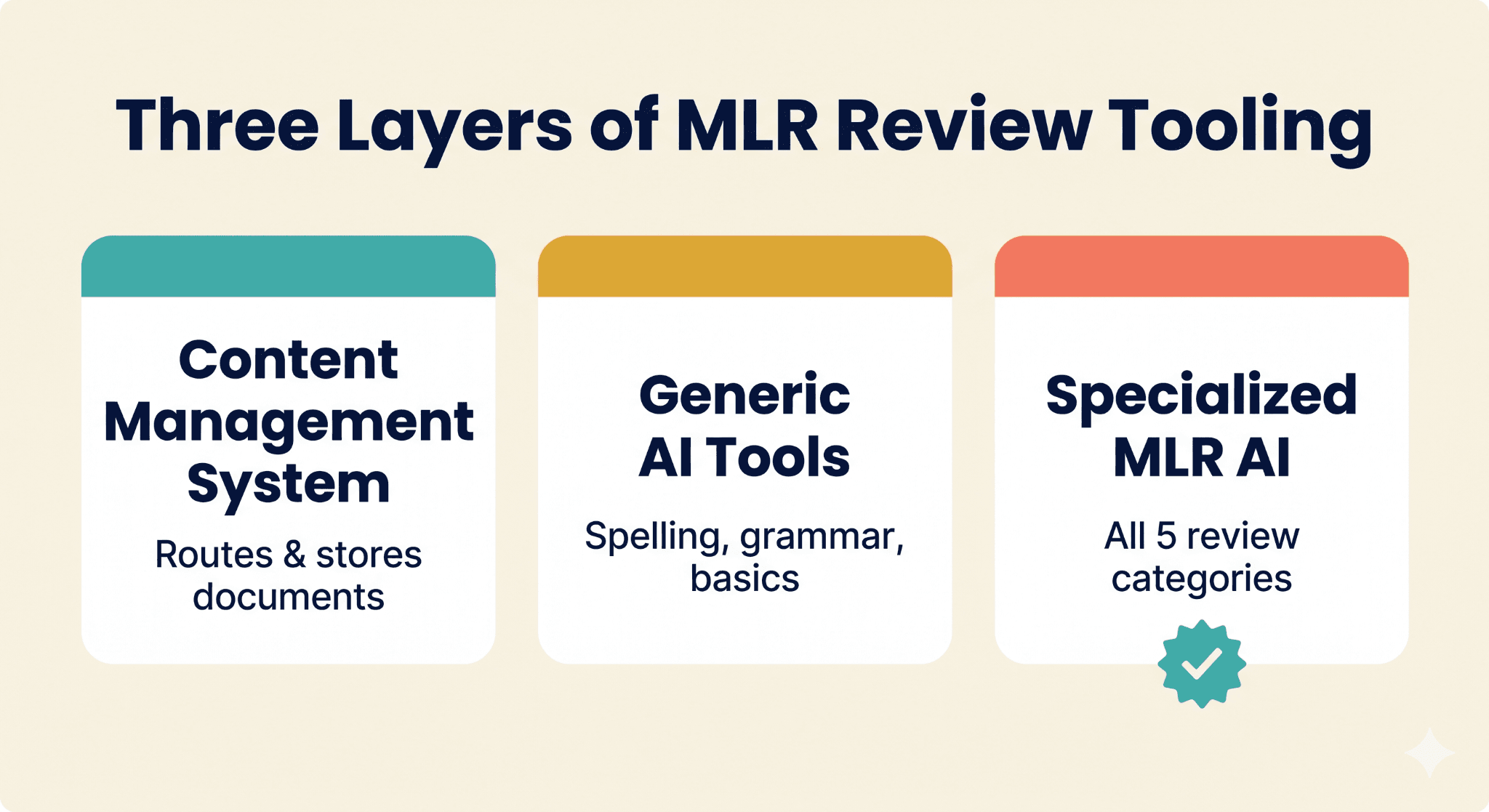
Tool Category | Function | KPI Impact |
Content management system (CMS) | Document storage, routing, version control, approval capture, audit trail | Supports on-time completion tracking and audit readiness |
Generic AI review tools | Spelling, grammar, basic editorial checks | Minor reduction in editorial revision categories |
Specialized pharma MLR AI review software | Compliance evaluation across all five MLR review categories: regulatory, claims substantiation, fair balance, editorial, market compliance | Reduces rework rate, first-pass failure, and elapsed cycle time |
One capability particularly relevant to the claims library utilization KPI is automated claims extraction: AI that pulls approved language from existing cleared materials and organizes it into a searchable reference for writers at the point of drafting. That upstream access drives higher first-pass approval rates downstream. The case for eliminating repeat claims work details how this plays out in practice.
FAQ
What is MLR review management?
MLR review management is the operational oversight of a pharmaceutical company's promotional review process, including the workflows, metrics, tools, and governance structures used to move marketing content through medical, legal, and regulatory review efficiently and compliantly. It covers day-to-day queue management and the longer-term measurement programs that give MLR operations leaders the visibility needed to make the process predictable and improvable.
What KPIs should an MLR dashboard track?
The most useful views track cycle time by stage, throughput by period and brand, first-pass approval rate, rework rate, time in queue, and on-time completion against established turnaround targets. Compliance views should also include approval timestamps, version history, and audit trail completeness for Form 2253 readiness.
How does bottleneck analysis work in a promotional review process?
Bottleneck analysis involves breaking total review cycle time into stage-level segments and identifying where time accumulates disproportionately. Common locations include the submission queue before any reviewer engages, the claims substantiation stage when reference materials are incomplete, and revision loops that recur because upstream quality issues remain unresolved. Stage-level data is required to make this analysis actionable.
What separates a CMS from specialized pharma MLR AI review software?
A content management system handles file storage, routing, version control, and approval capture: workflow infrastructure, not compliance evaluation. Specialized pharma MLR AI review software evaluates content against regulatory requirements, claims substantiation standards, fair balance obligations, and editorial guidelines. The two categories typically work together, with the CMS as the system of record and the specialized AI performing compliance analysis within it or alongside it.
How do promotional review analytics support continuous improvement?
Longitudinal process data separates systematic improvement from ad hoc fixes. When teams track revision category distribution, first-pass approval rate, and review cycle time across quarters, they can assess whether initiatives are working and where the next opportunity lies. Without that historical view, efficiency gains in one stage often reappear as delays elsewhere.
Building a Measurable MLR Review Management Program
The leaders who manage their review process most effectively are those who have built a measurement framework that makes performance visible, legible, and improvable. Cycle time data becomes a navigation instrument. The MLR dashboard becomes a shared language across operations, brand, and compliance functions. Promotional review analytics keep improvements accountable over time. The five KPIs outlined here are a calibrated starting point for any team ready to move from anecdotal oversight to structured process management.
Revisto is a specialized pharma marketing compliance platform built to support this kind of data-driven approach to MLR review management. Its AI MLR Engine evaluates promotional content across all five review categories to reduce upstream rework.
To explore how Revisto fits within your team's existing review infrastructure, request a demo and speak with the team about your measurement gaps.