
Key TakeawaysFor regulated teams evaluating medical legal regulatory review software, the relevant comparison is not document management against AI review, but generic AI tools against pharma-specific MLR platforms that combine compliance intelligence with the audit and validation expectations of an FDA-regulated system.
Software selection for promotional review in a regulated environment is a regulatory question first and a productivity question second. |
|---|
Selecting medical legal regulatory review software for a regulated pharma team is a different exercise than selecting most enterprise software. The buyer is not only choosing a productivity tool. The buyer is choosing a system that will hold promotional review evidence, capture reviewer decisions, and stand up to inspection. Heads of Regulatory and Compliance, working with IT counterparts who own validation and change control, sit at the center of that decision.
The stakes have risen. FDA's 2025 enforcement activity on promotional materials reached the highest annual total in nearly twenty-five years, with more than 200 enforcement letters tied to prescription drug advertising and promotion. Those letters reach beyond the marketing team. They reach the system of record that holds the materials, the reviewer signatures, and the version history. This piece is written for the regulated audience evaluating purpose-built MLR platforms and considering what an FDA-regulated environment requires of any system used in promotional review.
What Makes Medical Legal Regulatory Review Software Different From Generic Document Tools?
Most regulated teams have several existing systems involved in promotional content: a content management platform that stores files and routes them through approval, productivity software where authors draft materials, and increasingly some form of general-purpose AI for spelling, grammar, and editorial pass. None of these is purpose-built MLR review software in the strict sense. Each addresses a different layer of the content lifecycle.
Built Around the Promotional Review Workflow
Medical legal regulatory review software is purpose-built for the specific work performed during MLR review: claim verification, fair balance evaluation, regulatory checks against approved labeling, brand and editorial conformance, and channel-specific rule application. The artifact a reviewer produces in this system is not a generic comment on a document. It is a finding tied to a specific compliance category, with a reasoning chain that can be reviewed, accepted, or overridden by a human reviewer. The chain of evidence remains attached to the record so the basis for each decision is reconstructable later, whether for internal QA review or an audit. This is the meaningful difference from generic document review tools. A general AI tool reads text. A pharma-specific platform reads promotional content through the lens of an established MLR review framework and produces output structured for that framework. The reviewer remains the decision-maker, but the inputs that reach the reviewer are organized to match how medical legal regulatory review is actually conducted.
Compliance Intelligence Across the MLR Categories
A complete MLR review in pharma covers regulatory compliance against agency standards, claim substantiation against approved references, fair balance between benefit and risk, editorial and brand conformance, and market and channel rules that vary by audience and geography. Software that covers only one or two of these categories is closer to a writing assistant than to an MLR review platform.
This distinction is increasingly material as buyers compare options. The shift from generic AI to specialized AI trained on pharma is one of the central dimensions on which buyers now evaluate any pharma marketingspecific platform.
Which Regulatory Frameworks Govern MLR Review Software?
Promotional review records have always carried regulatory weight. When that record is held electronically, the system holding it falls under a defined set of expectations. Teams evaluating MLR software for a regulated environment work through these frameworks before they work through feature lists.
21 CFR Part 11 and Electronic Records Expectations
The foundational US framework is 21 CFR Part 11. The FDA's Part 11 scope and application guidance sets out a risk-based approach to which electronic records are subject to Part 11 and which controls remain enforced regardless of the agency's enforcement discretion in specific areas. Records that replace required paper records, or that are relied on to perform regulated activities, fall within scope. Promotional review records that document approvals tied to FDA-regulated promotional activities are typically treated as Part 11 records by regulated companies.
Subpart B of Part 11 sets out the controls for electronic records, including system validation, access limits, time-stamped audit trails, and the ability to generate accurate, retrievable copies. Subpart C addresses electronic signatures, covering unique attribution, signature meaning, and the controls that bind a signature to its record. Buyers evaluating a closed system, where access is controlled by the system owner, work through one set of expectations under section 11.10. Open systems, where data passes outside the system owner's direct control, carry additional encryption and authentication expectations under section 11.30. Most pharma promotional review deployments are closed systems for Part 11 purposes.
For software vendors and buyers, the practical implications cover access controls, signature meaning, audit trail expectations, system validation, and record retention through retrieval windows that may extend years past the original review. Data integrity principles often summarized as ALCOA-plus (attributable, legible, contemporaneous, original, accurate, complete, consistent, enduring, and available) inform how regulators read those records during inspection and how regulated teams design their own review of any candidate platform.

Audit Trails, Electronic Signatures, and Traceability
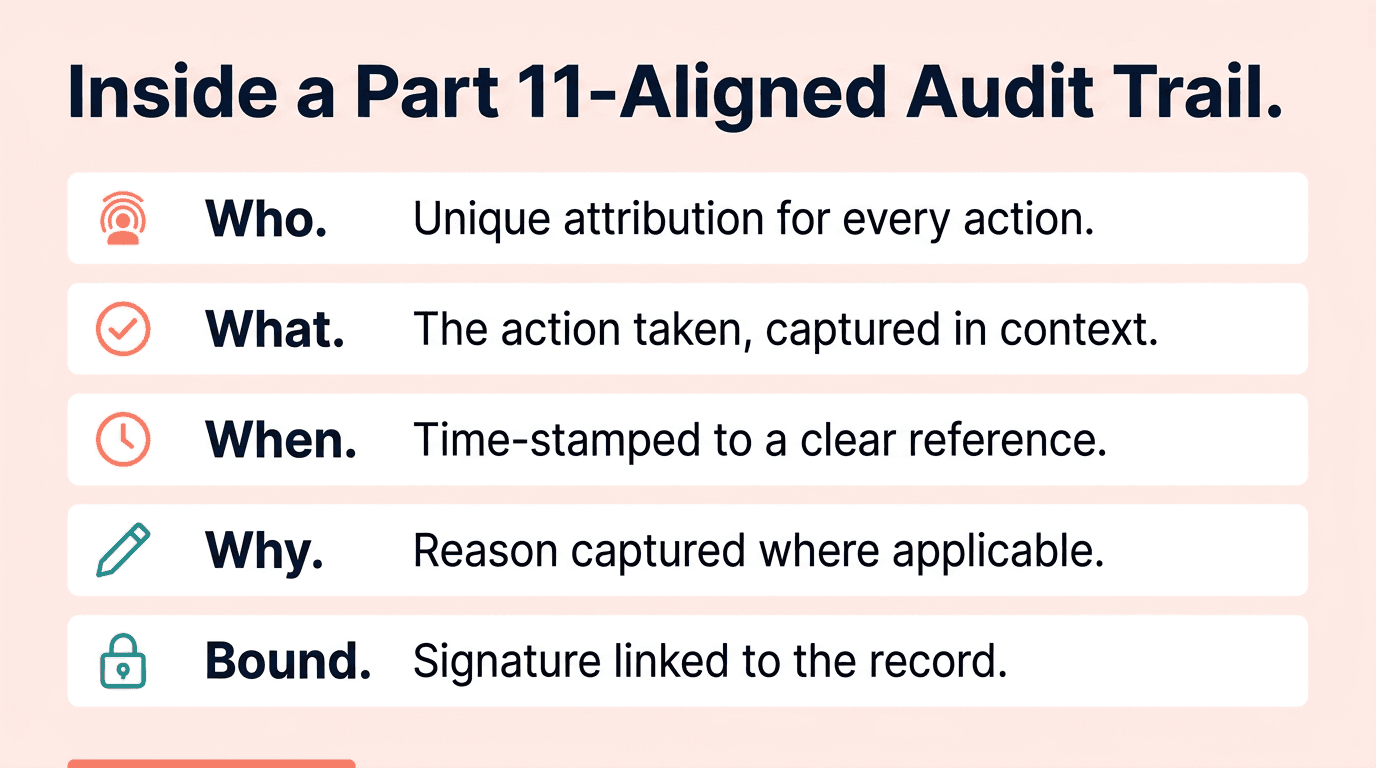
The audit trail is the part of an MLR review platform that regulated teams scrutinize most carefully. A Part 11-aligned audit trail captures who took an action, what action was taken, when it occurred, and where applicable, the reason. For a medical legal regulatory review system, that means every reviewer comment, claim flag, override, and approval routing decision needs to be recorded in a way that cannot be silently modified. Electronic signatures applied during MLR review carry the same controls expected of any FDA-regulated electronic signature: unique attribution, secure linking to the record signed, and a documented meaning for the signature in context.
The practical questions during evaluation include how the audit trail records prior values when content or metadata is modified, how reason codes are captured when signatures or rejections are applied, how the audit trail is rendered in human-readable form for inspection, and how exports support both routine internal review and external regulatory requests. Reviewer roles often need to be distinguished within the audit trail to support traceability across medical, legal, and regulatory functions, particularly when reviewers in different jurisdictions sign sequentially. Time stamping needs a clear time zone reference so signatures from globally distributed reviewers remain reconcilable.
FDA's 2024 final guidance on Part 11 in clinical investigations, summarized in this recent FDA Part 11 guidance update, reinforced expectations around documenting which electronic systems are used in regulated activities and how access, training, and audit trail capture are managed. The principles translate directly to MLR review systems used in promotional review.
International Equivalents and Harmonization
Teams supporting global product launches need to consider EU Annex 11, the European counterpart to Part 11 under the EU GMP framework, along with similar requirements in other jurisdictions. The expectations align on the central themes: validated systems, controlled access, secure audit trails, and reliable retrieval. Where promotional review software is deployed across regions, the system needs to satisfy the strictest applicable framework, with the controls and documentation to demonstrate that during inspection.
How Do Tooling Categories Compare for MLR Review?
The table below maps the three tooling categories side by side, with the function each layer performs and how it relates to MLR review.
Tooling category | Primary function in the content lifecycle | Relationship to MLR review |
|---|---|---|
Content management system | File storage, version control, routing, approval capture | System of record alongside MLR review software; does not perform compliance evaluation |
Generic AI review tools | Spelling, grammar, editorial pass on text | Not equipped for pharma compliance categories or audit trail expectations |
Specialized pharma MLR AI software | Compliance evaluation across the five MLR categories with audit trail | Purpose-built layer that complements the CMS and supports human reviewers |
The meaningful evaluation comparison for buyers sits between generic AI review tools and specialized pharma MLR AI software. Both apply intelligence to the content, but at very different levels of compliance specificity.
Eight Buyer Considerations for Evaluating Medical Legal Regulatory Review Software
The following considerations recur across evaluations of medical legal regulatory review software. They are written for IT, regulatory, and compliance leaders who own the evaluation alongside marketing operations.
Compliance category coverage. Confirm the platform addresses regulatory compliance, claim substantiation, fair balance, editorial and brand conformance, and market and channel rules. Partial coverage requires the team to maintain manual review for missing categories.
Audit trail completeness. Review how the system captures user actions, timestamps, prior values for modified records, and the meaning of signatures applied during review. The export format used to support inspection is part of the same evaluation.
Validated state and change control. Ask the vendor for validation documentation, change control records for past releases, and the approach to validating AI model updates. The validation package should align with the team's existing approach under risk-based validation.
Specialization for pharma promotional review. General-purpose AI applied to promotional content can flag grammar and tone, but pharma-specific intelligence around claim substantiation, on-label use, and fair balance requires training and tuning that platforms built for adjacent industries usually lack.
Claims library construction. Promotional review depends on a current, organized body of approved claims that reviewers and writers can reference. Platforms that build a dynamic claims library from existing approved materials reduce the manual upkeep that otherwise consumes reviewer capacity.
Integration with the existing content management platform. For pharma teams already operating on a CMS of record, the practical question is how MLR software complements that system without creating a parallel record. Embedded deployment within the existing CMS keeps reviewer workflow continuous and the system of record consolidated.
Reviewer accountability and human-in-the-loop design. A platform that surfaces findings for reviewer decision is different from one that auto-approves content. Regulated teams retain final decision authority on every flag, with the system providing the evidence trail.
Security, hosting, and data residency. Cloud architecture, regional data residency, encryption practice, and SSO and access management approach all factor into the IT review. Role-based access tied to distinct MLR reviewer roles is part of the same evaluation.
How Should Regulated Teams Approach Validation and Change Control for MLR Software?
Validation is where IT, Quality, and Regulatory functions converge on MLR software evaluation. The level of validation rigor applied to a medical legal regulatory review platform depends on the team's risk-based approach and the intended use of the system, framed against the agency's emphasis on demonstrating that a system is fit for its intended use.
Validation Approach
A risk-based validation approach for an MLR platform typically considers the system's role in producing or supporting Part 11 records, the population of users involved, and the downstream impact of system behavior on promotional review decisions.
The validation documentation package usually includes user requirements, functional specifications, qualification protocols, and a traceability matrix back to those requirements. Vendor documentation can support significant portions of the package, with the buyer performing the remaining assurance work tied to their specific configuration and intended use.
The Computer Software Assurance approach the FDA has been articulating over the past several years places emphasis on critical thinking about intended use and on assurance activities scaled to risk, rather than on documentation volume. For MLR review software, this means asking which system functions actually affect regulated records, which carry compliance risk, and where reviewer judgment is the safeguard. Testing scope can be reduced for functions that pose lower risk and increased for functions where AI-generated findings feed directly into reviewer decisions on regulated promotional content.
Change Control for AI-enabled Systems
An AI-enabled MLR platform introduces a change control question that traditional software does not. Models update, training data evolves, and behavior can shift in ways that require revalidation triggers. Buyers should ask the vendor how model changes are communicated, how prior outputs remain reproducible for audit purposes, and how the team can validate AI behavior against a defined set of test cases that reflect their content portfolio. Specialized pharma AI generally has narrower scope than general-purpose models, which often makes change control more tractable.
Vendor Qualification
Vendor qualification follows the same pattern applied to any regulated software supplier. Documented quality management practices, security certifications, software development lifecycle documentation, and the ability to support audit and inspection are all assessed. The qualification record then becomes part of the deployed system's documentation set, supporting both initial validation and ongoing change control.
For AI-enabled platforms, vendor qualification extends to how the vendor manages training data provenance, how model versions are tracked, and how the vendor supports regulated buyers who need to demonstrate that their deployed configuration corresponds to validated outputs. Documented procedures for handling model retraining, prior version retention, and customer notification when material model changes occur are part of the qualification evidence that buyers in regulated environments expect to review.
What Deployment Patterns Are Available, and How Do Regulated Teams Choose?
Pharma teams enter MLR platform evaluation from different starting positions. Some operate established CMS infrastructure with mature workflows. Others, including agencies and smaller teams, work without that infrastructure in place. MLR review in pharma can run on a standalone platform or through AI agents embedded within an existing CMS, and the choice between the two is a context-based decision rather than a ranking.
Deployment pattern | Best-fit context | Where reviewer work happens |
|---|---|---|
Standalone MLR review platform | Agencies and teams without established CMS infrastructure; pre-review use cases | Within the dedicated review platform |
AI agents embedded within existing CMS | Pharma teams already operating an established CMS of record | Within the existing CMS interface |
Both deployment patterns serve buyers operating under the same regulatory frameworks. The platform under either deployment needs to satisfy Part 11 expectations, validation requirements, and the team's change control discipline. Selection follows the existing infrastructure, the buyer's preferred locus of reviewer work, and the integration model that fits the broader content stack.
FAQ
What is medical legal regulatory review software?
Medical legal regulatory review software is a category of pharma marketing compliance software purpose-built for the MLR review process, in which medical, legal, and regulatory reviewers evaluate promotional content before it reaches healthcare professionals, patients, or caregivers. The platform supports reviewers across the five MLR categories of regulatory compliance, claim substantiation, fair balance, editorial and brand conformance, and market and channel rules, with audit trails and electronic signatures aligned with FDA expectations.
Is MLR review software covered by 21 CFR Part 11?
Promotional review records held electronically in place of paper, or relied on to perform regulated activities, are generally treated as Part 11 records by pharma companies. The Part 11 controls that remain enforced regardless of the FDA's enforcement discretion include access controls, electronic signature requirements, and the underlying predicate rule expectations for the records themselves. Regulated buyers therefore evaluate medical legal regulatory review software against Part 11 expectations as a matter of course.
How is MLR review software different from a content management system?
A content management system stores files, controls versions, routes documents through approval, and captures approvals as a record. A specialized MLR platform operates on the content within those documents, producing compliance findings against pharma-specific review categories that a reviewer evaluates. The two layers are complementary. MLR software does not replace the CMS, and the CMS does not provide the compliance intelligence that a specialized MLR platform supplies.
What should validation look like for AI-enabled MLR review software?
Validation follows a risk-based approach focused on intended use and the system's role in producing or supporting regulated records. A typical package includes user requirements, functional specifications, qualification protocols, and a traceability matrix. AI components introduce additional considerations around how model changes are managed, how prior outputs remain auditable, and how the buyer can re-test against a defined set of representative cases tied to their content portfolio.
Does medical legal regulatory review software replace human reviewers?
No. A purpose-built platform is designed to support human-in-the-loop review. It surfaces findings, organizes evidence, and accelerates the work of reviewers across the MLR categories, but reviewers retain decision authority on every flag, comment, and approval. The regulatory framework that governs MLR review in pharma presumes accountable human reviewers, and well-designed software preserves that accountability rather than displacing it.
Closing: A Regulatory Question First
For regulated pharma teams, medical legal regulatory review software selection sits at the intersection of compliance, IT, and reviewer workflow. The evaluation criteria that matter most in a regulated environment have less to do with general-purpose features and more to do with the regulatory expectations that apply to any system holding promotional review records.
Audit trail design, validation posture, change control discipline, and category coverage across the five MLR review areas are the dimensions that separate adequate platforms from the ones that will hold up under inspection and across a global review portfolio. The buyer journey for regulated teams therefore tends to look more like a regulated software supplier qualification in addition to being a productivity tool evaluation.
Revisto's MLR review platform is purpose-built for pharma promotional review, with five specialized AI engines spanning the full set of MLR categories and deployment options that fit teams operating in or alongside an existing CMS. Reach out to our team to discuss how the platform fits your validation, audit, and reviewer accountability requirements.