
Key TakeawaysSelecting an AI MLR vendor is a high-stakes decision that shapes review quality, reviewer workload, and regulatory exposure for years.
Before any conversation, define which MLR categories your current process underevaluates and build your vendor questions around those gaps. |
|---|
When a prospective AI MLR vendor arrives with a polished demo and a promise of shorter review cycles, the pressure to move quickly is real. Promotional review bottlenecks are costing life sciences marketing teams measurable time and budget. But the selection decision carries its own risk profile. A platform that covers only part of the MLR review scope, conflicts with existing content management infrastructure, or cannot produce audit documentation that meets regulatory standards can introduce more exposure than it removes.
This guide is for MLR operations leaders, regulatory affairs directors, and marketing compliance teams moving into active vendor evaluation. It covers five dimensions that separate purpose-built pharma marketing compliance software from general-purpose alternatives: compliance category coverage, deployment and workflow fit, security and data governance, proof of value, and implementation planning. The goal is to give your team the criteria needed to make a defensible selection decision.
It is also worth naming what this guide does not cover. Content management platforms handle file routing, version control, and approval capture. Drafting and creative production belong to marketing and agency teams. The platform you select sits in between: surfacing compliance issues before human reviewers make final determinations, in alignment with the review standards the FDA Office of Prescription Drug Promotion enforces across promotional labeling and advertising.
What Should an AI MLR Vendor Actually Review?
The most consequential difference between vendor options is not interface design or pricing. It is the scope of what the AI actually evaluates. Promotional review has five distinct compliance categories, and most AI MLR review software does not address all of them.
The five compliance categories and why coverage gaps matter
The five categories are: Regulatory Compliance (alignment with FDA, EMA, and regional standards), Claim Substantiation (validation against approved claims and clinical evidence), Fair Balance (ensuring risk information is presented with appropriate prominence), Editorial and Brand Guidelines (trademark usage, grammar, and consistency), and Market and Channel Compliance (channel-specific SOPs and local market requirements).
A platform that handles editorial review but cannot evaluate claim substantiation leaves the most labor-intensive part of the MLR process to your reviewers manually. Fair balance deficiencies are among the most frequently cited issues in FDA OPDP enforcement letters. When evaluating any platform, ask for a demonstration of how the system handles each category with an actual promotional piece, not a category checklist in a presentation.
This is where the difference between general-purpose AI tools and purpose-built MLR review software becomes decisive. General AI catches grammatical errors and formatting inconsistencies. Specialized AI can evaluate whether a claim is substantiated against an approved claims library and whether fair balance meets OPDP standards. The distinction between general and specialized AI is worth understanding before you build your vendor shortlist.
MLR Review Category | General AI Tools | Specialized AI MLR Platforms |
|---|---|---|
Regulatory Compliance | Limited; no pharma-specific regulatory training | Purpose-built for FDA, EMA, and regional standards |
Claim Substantiation | Not addressable without claims library integration | Core capability; validates against approved claims and clinical data |
Fair Balance | Cannot evaluate risk-benefit presentation standards | Evaluates disclosure pairing against OPDP expectations |
Editorial & Brand Guidelines | Strong; spelling, grammar, trademark basics | Strong; also learns client-specific brand SOPs |
Market & Channel Compliance | Not addressable; no knowledge of channel SOPs | Evaluates channel rules and local market requirements |
How Does Deployment Model Affect Adoption?
Even a technically capable platform underperforms if your team does not use it consistently. Deployment model is one of the most underweighted variables in vendor evaluations, with a direct effect on adoption and return on implementation investment.
Standalone workspace vs. embedded deployment
The two primary deployment models for AI MLR review software are standalone workspaces and platforms embedded within your existing content management infrastructure. A standalone workspace gives reviewers a purpose-built environment with its own interface and review queue management. This model fits teams that prefer a dedicated review environment.
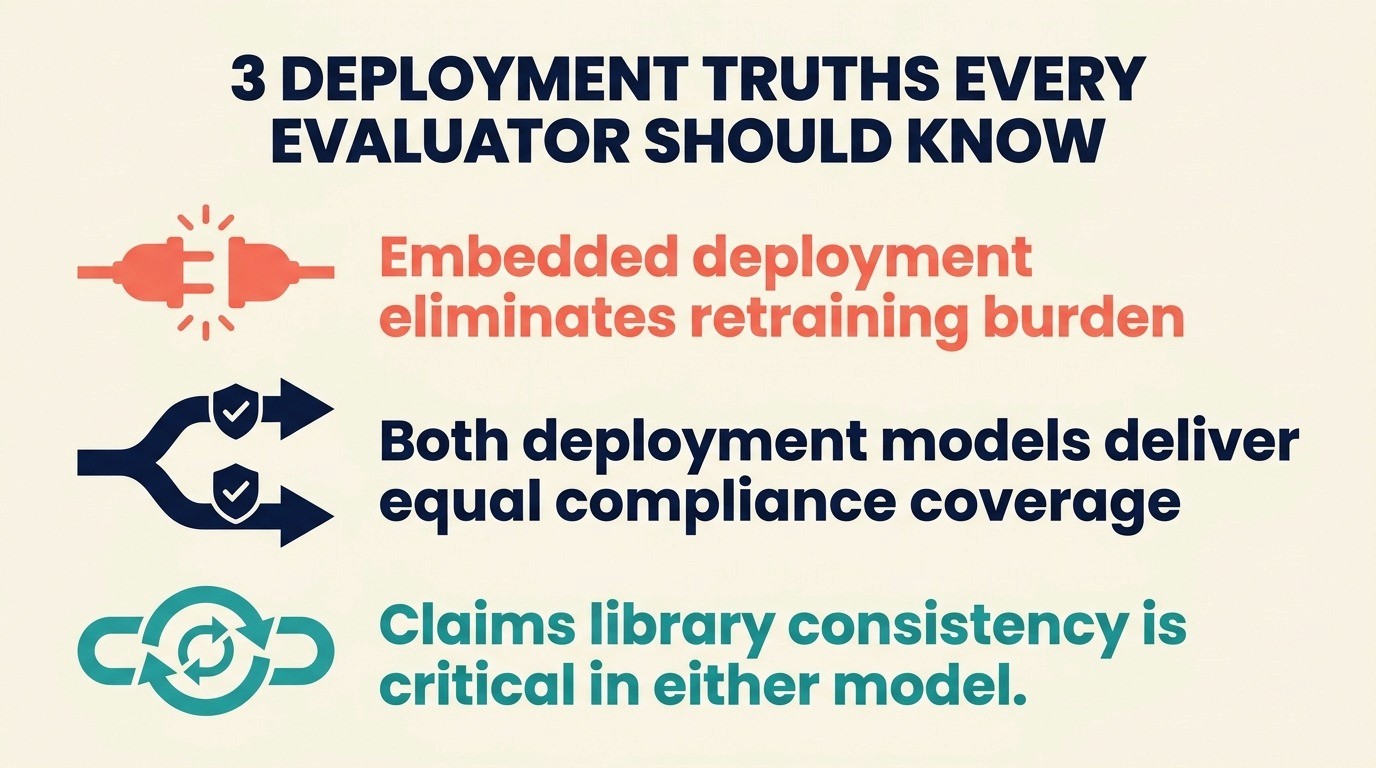
Embedded deployment means the AI review layer runs inside the CMS your team already uses, surfacing results within a familiar interface. For organizations with established CMS infrastructure, this model eliminates retraining burden. Adoption friction is one of the primary reasons AI implementations in regulated industries underperform expectations, and any tool that requires a consistent context switch will face that friction.
When comparing deployment options, ask each vendor how their platform handles the handoff between your content management system and the AI review layer. Ask whether the claims library and extraction capabilities function consistently across both deployment modes.
Evaluation Dimension | Standalone Workspace | Embedded in Existing CMS |
|---|---|---|
Reviewer learning curve | New interface to learn | Minimal; works within familiar environment |
Collaboration features | Built into the platform natively | Depends on context; varies by implementation |
Integration complexity | Depends on context | Depends on context |
Claims library access | Equal | Equal |
Compliance coverage depth | Equal | Equal |
5 Questions to Ask Every AI MLR Vendor Before Shortlisting
Most vendor conversations begin with a demo optimized for the vendor's strengths. These five questions are designed to surface the structural variables that rarely appear in a standard presentation.
Which of the five MLR review categories does your platform evaluate, and can you demonstrate each one with a live document? Coverage claims on a slide and coverage demonstrated on your actual promotional materials are different things. Ask for a live walkthrough using content similar to what your team reviews regularly.
How does your system handle claims not yet in the approved library? New brand launches and expanded indications involve claims that have not been formally approved.
What audit trail does the platform produce, and how does it map to 21 CFR Part 11 requirements? Any electronic system involved in a regulated promotional review must produce a documented, tamper-evident record of what the AI evaluated, what it flagged, and what reviewers subsequently approved. Ask to see a sample audit report.
How is training data governed, and does your model train on customer-submitted content? Some AI platforms use customer data to improve their models. Require explicit contractual language on this point before proceeding.
What does your proof-of-value process look like, and what metrics do you track? A credible AI MLR vendor should articulate how they define success during a pilot and what measurements they use against your baseline.
What Security and Data Governance Standards Should You Require?
Promotional materials contain competitively sensitive information: pre-launch campaign strategy, unreleased indication data, and proprietary clinical messaging. The data governance requirements for a specialized review platform are not the same as those for a general enterprise SaaS tool.
Regulated environment requirements for AI review systems
Software systems involved in pharmaceutical promotional review are subject to the electronic records and signature requirements set out in 21 CFR Part 11. At minimum, the system must maintain a secure, computer-generated, time-stamped audit trail capturing every action on a reviewed document.
Beyond the regulatory baseline, consider how the vendor handles data residency, model training practices, and security certification. Life sciences organizations evaluating pharmaceutical compliance software for the promotional review category should require SOC 2 Type II certification, along with explicit contractual terms around data retention and the prohibition of customer content in model training. For a framework on responsible AI governance in healthcare contexts, responsible AI principles for life sciences teams offers practical starting criteria alongside your vendor questionnaire.
Human-in-the-loop is a design requirement, not a feature
AI review in a regulated pharmaceutical environment does not replace human judgment. What changes is the shape of the work: instead of evaluating every document across every category from scratch, reviewers engage with a structured set of flagged items organized by category and priority. The platform you select should be designed explicitly around this model, with output structured to support reviewer decisions rather than to substitute for them.
This distinction affects what accuracy means in a demo. A system that flags everything is not useful. A system that flags the right things, in the right categories, with enough context for a reviewer to make a fast determination, is the one that actually improves throughput. This calibration is the core value of purpose-built MLR AI review software, and it is worth testing directly during a pilot before any purchase commitment.
FAQ
What is the difference between an AI MLR vendor and a content management system like Veeva Vault PromoMats?
A content management system handles file storage, routing, version control, and approval capture. An AI MLR vendor provides the compliance intelligence layer, evaluating whether the content in those files meets regulatory, legal, and medical standards before human reviewers make final calls. Purpose-built platforms operate either as standalone workspaces or as embedded tools within CMS environments, including within Veeva itself.
How do I know whether my team needs specialized AI or a general AI writing tool?
The clearest diagnostic is whether the tool can evaluate claims substantiation. General AI checks grammar and formatting. A purpose-built AI MLR review platform evaluates whether a claim is supported by approved clinical evidence, whether fair balance requirements are met, and whether channel-specific SOPs are followed. If your review process involves any of those categories, a general tool does not address the underlying bottleneck. The getting started with AI in MLR guide walks through how to assess your team's current gaps before selecting a platform.
What proof of value should I expect from an AI MLR vendor pilot?
A well-structured pilot should produce measurable data on at least two dimensions: cycle time reduction at a defined review stage, and issue detection rate compared to a baseline of similar materials reviewed without AI assistance. Pilots that measure only speed without tracking coverage quality give an incomplete picture. A faster review that misses compliance issues is not a successful outcome.
How should our team evaluate pharmaceutical compliance software specifically for the marketing review process?
Start by separating pharmaceutical compliance software into two distinct categories: tools designed for drug development and clinical documentation, and tools designed for promotional material review. The evaluation criteria in this guide apply to the latter. Within that category, the primary variables are MLR category coverage, deployment model compatibility with existing infrastructure, and the vendor's track record at similar content volume.

Moving from Evaluation Criteria to a Decision
The questions in this guide are designed to surface what actually matters: what the platform evaluates, how it fits your existing workflows, what data governance your compliance teams require, and how you will measure whether it is working.
The right platform depends on where your current process breaks down. For organizations where claims substantiation is the primary bottleneck, coverage depth in that category is the evaluation priority.
For teams where past tool adoption has stalled, deployment model and CMS compatibility deserve the most scrutiny. Revisto is purpose-built for pharmaceutical and life sciences promotional review, covering all five MLR categories across both standalone and embedded deployment models. If you are in the early stages of an AI MLR vendor evaluation and want to pressure-test these criteria against a working platform, request a demo with the Revisto team to see how it performs against your specific review environment.