
Key TakeawaysAI in omnichannel pharma marketing only delivers on its promise when review capacity grows alongside content volume.
The teams advancing fastest in pharma omnichannel marketing are not the ones producing the most content. They are the ones building review infrastructure that keeps pace with their ambitions. |
|---|
Pharma omnichannel marketing has moved from strategic aspiration to operational pressure. Life sciences marketing teams are expected to deliver coordinated, personalized campaigns across HCP and patient audiences spanning digital, print, email, social, and in-person channels. Each of those channels requires tailored content. Each piece of tailored content requires MLR review. And that is where most omnichannel strategies stall.
The question facing operations leaders is not whether to pursue AI in omnichannel pharma marketing. The question is whether the review infrastructure supporting that strategy can keep pace with content at scale. Expanding channel coverage without expanding review capacity produces a predictable outcome: longer cycles, more rework, and personalization that gets sacrificed in the interest of speed. Understanding how AI changes that equation requires looking at where the bottleneck actually forms.
According to a 2025 Deloitte global survey of pharmaceutical executives and healthcare professionals, 82 percent of life sciences executives report satisfaction with their current engagement strategies — while only 28 percent of HCPs feel those strategies actually meet their needs. That gap is not a messaging problem. It is an infrastructure problem, and at its center sits a review process that was never designed to support the volume and variety of content that true omnichannel requires.
Why Does Omnichannel Scale Break MLR Review?
True pharma omnichannel marketing does not mean sending the same approved email to a broader list. It means producing HCP-specific messaging for different specialties, patient-facing content for distinct audience segments, and channel-appropriate versions of each, all aligned to the same brand and regulatory standards. The content volume that model requires is qualitatively different from what most MLR review operations were built to handle.
The structural issue is that MLR review was designed around individual assets reviewed sequentially. Omnichannel flips that model: assets multiply, channels diversify, and timelines compress. Without a corresponding shift in how review is conducted, teams face a ceiling that marketing ambition alone cannot raise. The case for AI in omnichannel pharma marketing rests on whether AI-assisted review can absorb that expanded volume without compromising the compliance standards that govern every asset.
The Asset Multiplication Problem
A single campaign claim that needs to appear across a detail aid, an email, a banner ad, a social post, and a patient brochure does not require one review. It requires five, each evaluated against the specific requirements of its channel. Channel-specific compliance rules govern character limits, required disclosures, fair balance presentation, and platform-specific restrictions. As omnichannel programs expand, asset counts compound quickly. As pharma marketing professionals have observed, brand teams have been quicker to adapt to omnichannel delivery than MLR review processes have, because the review infrastructure itself requires a fundamentally different approach. The volume multiplication that omnichannel requires was never part of how MLR review capacity was originally sized.
The downstream effect is consistent across organizations: approval timelines extend, campaigns miss launch windows, and teams default to reusing broadly approved content across audiences that warrant more targeted messaging. The connection between review throughput and omnichannel execution is direct. Slower review means less personalization, fewer channels activated on schedule, and audience insights that are outdated by the time content reaches them.
Why Generic AI Tools Do Not Close the Gap
General-purpose AI editorial tools can identify spelling errors, flag passive voice, and suggest rewrites. They were built for those tasks. They were not built to evaluate whether a claim in a diabetes medication brochure is adequately substantiated by the cited clinical data, whether a fair balance section adequately pairs a stated benefit with the required risk disclosure, or whether a social post meets FDA guidance for the specific format and audience.
Pharma MLR AI review software is a distinct category. The compliance evaluation required for promotional review demands domain-specific training on regulatory frameworks, clinical evidence standards, and channel-specific requirements across all five MLR review categories: Regulatory Compliance, Claim Substantiation, Fair Balance, Editorial and Brand Guidelines, and Market and Channel Compliance. Generic tools address, at best, the last of those.

What Does Compliant Personalization Actually Require?
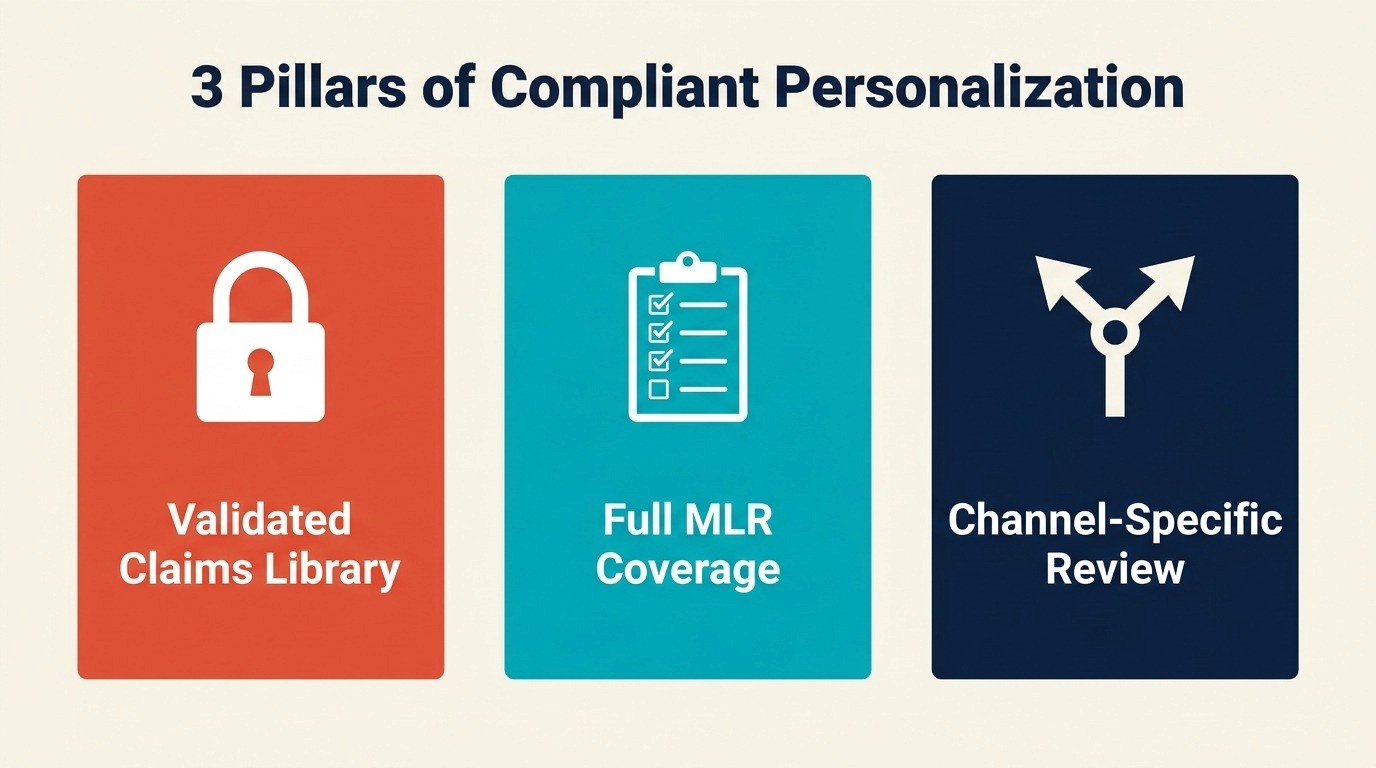
Personalization in pharma omnichannel marketing is not a creative challenge first. It is a compliance architecture challenge. Before a marketing team can personalize effectively at scale, the foundational content infrastructure has to support it. That means knowing which approved claims exist, what evidence supports each one, and which audience contexts those claims can appear in.
The teams that achieve compliant personalization at scale are not generating new claims for each audience segment. They are assembling content from a structured library of pre-reviewed, validated language, then routing those assets through a review process that can evaluate channel-specific compliance requirements without re-litigating underlying claim substantiation each time.
The Role of a Claims Library in Omnichannel Operations
A validated claims library is the upstream infrastructure that makes pharma omnichannel marketing operationally feasible. When writers have access to a searchable library of claims, including the supporting evidence and the approved language, they are not starting from scratch with each new asset. Review cycles shorten because reviewers are evaluating assembly and channel fit rather than re-substantiating claims reviewed previously. The operational value of claims extraction compounds as campaign volume grows: every previously reviewed asset becomes source material that reduces future review burden.
The challenge is that most life sciences organizations do not have a well-maintained claims library. They rely on spreadsheets, archived submissions, and institutional memory. Each new campaign effectively starts from zero, duplicating substantiation work done before and consuming reviewer time that could be applied to new content.
Fair Balance Across Channels
Fair balance is among the most operationally demanding requirements in pharma marketing compliance. The requirement to pair stated benefits with required risk disclosures does not relax because the channel is a social post or a digital banner. It adapts, and the specific application in each format requires specialized evaluation. A promotional review process that cannot consistently evaluate fair balance across channel types creates an exposure that scales with the number of channels the team is managing.
This is one reason why channel-specific compliance evaluation matters so much in an omnichannel context. FDA's Office of Prescription Drug Promotion reviews promotional materials across formats, including television, digital, print, and sales aids, each evaluated for truthfulness, balance, and accurate risk representation. An omnichannel content review process that applies a single general compliance check across formats leaves channel-specific gaps that reviewers must close manually.
How Do Review Approaches Compare Across the Content Operations Stack?
Three distinct layers of technology touch pharma content operations. Understanding what each one does prevents teams from expecting capabilities from a tool that was not designed to provide them.
Layer | Primary Function | MLR Compliance Role |
|---|---|---|
Content Management System | File storage, version control, routing, approval capture | System of record; does not evaluate compliance content |
Generic AI editorial tools | Grammar, style, general content quality | Surface-level checks; no pharma regulatory specialization |
Specialized pharma MLR AI review software | Compliance evaluation across all 5 MLR categories | Purpose-built for promotional review: claims, fair balance, regulatory, channel compliance |
The content management system and the specialized AI review layer serve different functions. An AI pharma marketing compliance platform works alongside the content management system, adding the compliance intelligence the CMS was not designed to provide. Teams do not choose between them; they need both.
5 Questions to Evaluate AI in Pharma Omnichannel Marketing
When assessing whether AI review infrastructure can support a pharma omnichannel marketing program at scale, these are the questions that reveal operational readiness.
Does the platform evaluate all five MLR review categories? AI in pharma omnichannel must handle Regulatory Compliance, Claim Substantiation, Fair Balance, Editorial and Brand Guidelines, and Market and Channel Compliance. Platforms that address only editorial quality or only claim matching leave significant review gaps that human reviewers must cover manually.
How does the platform handle channel-specific compliance rules? A digital banner and a printed detail aid face different format requirements, disclosure standards, and character constraints. An omnichannel content review platform should evaluate assets against the specific requirements of their intended channel, rather than applying a single general compliance check across formats.
Does it support claims library building from approved materials? The ability to extract approved claims from previously reviewed materials and organize them into a searchable reference is the upstream infrastructure that enables compliant personalization.
Does it work within existing workflows without requiring a full platform migration? Teams already operating within content management platforms should be able to access AI review capabilities without abandoning the tools and workflows they depend on. Embedded deployment options reduce adoption friction and allow AI-assisted review to begin without retraining entire teams.
Where does the human reviewer remain in control? AI-assisted review surfaces issues, flags potential compliance gaps, and accelerates the work reviewers do. Evaluating where and how human review remains primary is essential for any organization considering AI in omnichannel pharma marketing. The professional judgment of medical, legal, and regulatory reviewers is the final authority.
What Does AI-Assisted Omnichannel Content Review Look Like in Practice?
The practical benefit of AI-assisted review in a pharma omnichannel marketing context is not that it removes reviewers from the process. It is that reviewers spend their time on decisions that require human judgment rather than on tasks that can be systematically checked. For organizations seriously investing in AI in omnichannel pharma marketing, that shift in how reviewer time is allocated is the primary operational return.
When an asset reaches the MLR queue, a significant portion of review time historically goes to verifying that cited claims match their source documents, that fair balance language is present and appropriately prominent, that regulatory disclosures are included for the relevant channel, and that brand and editorial standards are met. These are systematic checks. AI systems trained on pharma regulatory and brand standards can complete them consistently and at speed, so reviewers can focus on the substantive compliance questions that require their expertise.
Reducing Rework Before Assets Reach Review
Much of the rework that extends MLR cycle times originates before assets reach formal review: claims that lack adequate substantiation, assets lacking fair balance, or channel adaptations that do not meet format-specific requirements. Addressing compliance gaps earlier in the process means giving content teams visibility into likely issues before submission, so assets arrive at the MLR queue in better shape and require fewer revision cycles.
For omnichannel content review specifically, earlier compliance signaling matters because asset volume is higher. A reduction in revision cycles on a single campaign matters less than that same reduction applied consistently across a coordinated omnichannel program with assets across multiple channels and audience segments.
Personalization Enabled by Validated Content Infrastructure
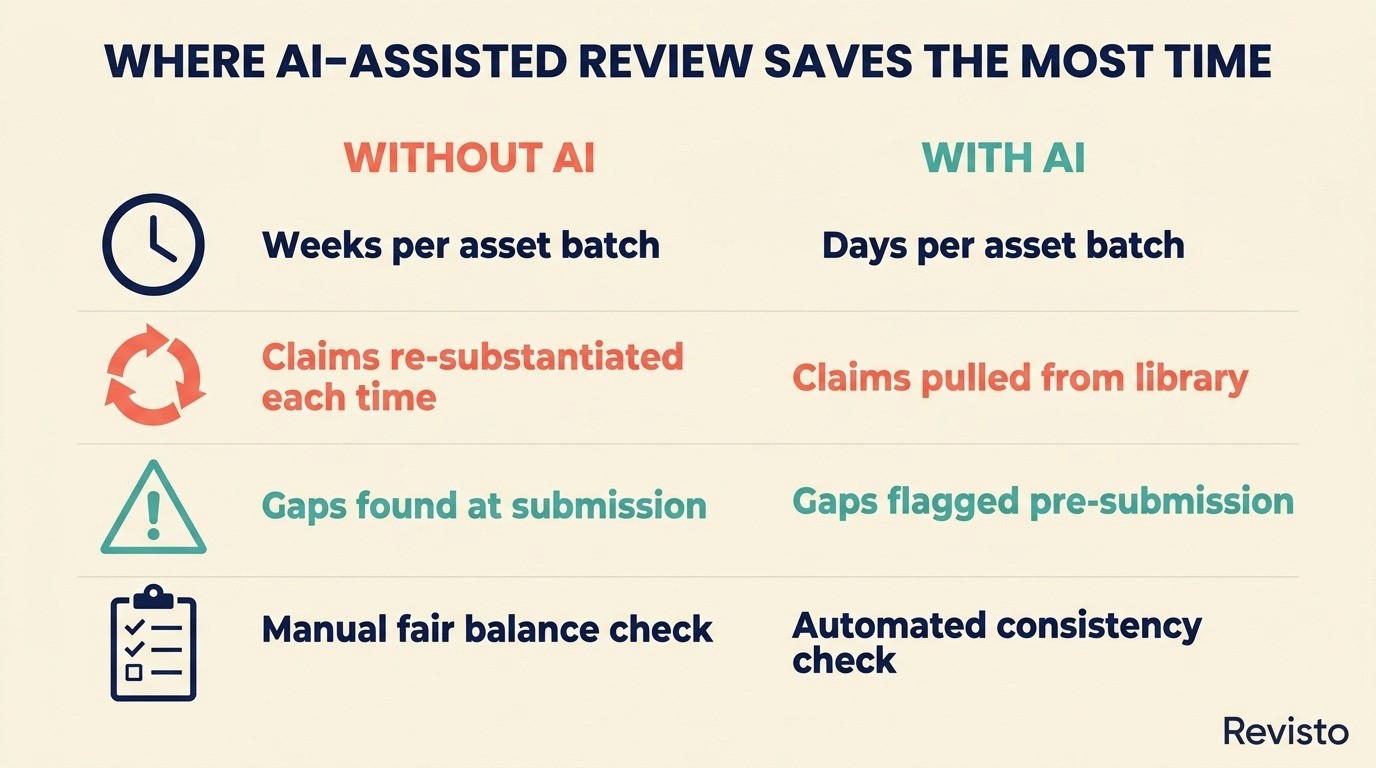
The connection between AI-assisted review and personalization at scale is not direct. AI MLR review builds and maintains the infrastructure that makes personalization operationally safe. When claims are validated and stored in a searchable library, when review cycles are shorter because systematic checks are handled consistently, and when channel-specific compliance can be evaluated at the asset level, marketing teams have the freedom to differentiate content for different audiences without each adapted version requiring a long review cycle.
This is the operational reality that makes AI in omnichannel pharma marketing meaningful beyond the headline. The goal is a content operations model where review capacity grows with content volume, and where compliance infrastructure supports personalization rather than constraining it.
Omnichannel Content Operation | Without AI-Assisted Review | With AI-Assisted Review |
|---|---|---|
New campaign launch | Weeks to months per asset batch; sequential review | Compressed cycles; systematic checks completed before human review begins |
Claims reuse across channels | Substantiation restarted each campaign | Validated claims library surfaces approved language for writer reference |
Fair balance evaluation | Manual check per asset by each reviewer | Consistent evaluation flagged for review; human confirms substantive calls |
Compliant personalization at scale | Limited by review throughput | Enabled by shorter cycles and validated content infrastructure |
Frequently Asked Questions
What makes AI in omnichannel pharma marketing different from standard marketing AI tools?
Standard marketing AI tools address general content quality, audience targeting, or campaign analytics. AI in omnichannel pharma marketing, in the context of MLR operations, refers to AI systems built to evaluate promotional content against regulatory requirements, claim substantiation standards, fair balance requirements, and channel-specific compliance rules. These are specialized functions that require domain-specific training on pharmaceutical regulatory frameworks. AI in pharma omnichannel operations specifically addresses the review throughput constraints that limit how much personalized, channel-adapted content a team can actually launch.
How does AI-assisted review support compliant personalization at scale?
AI-assisted review shortens the cycle time per asset, which means review teams can process more assets within the same time window. It also supports claims library building, extracting validated language from approved materials so writers working on personalized versions can draw from pre-reviewed content rather than generating new claims that require full substantiation. The result is that personalization becomes operationally feasible across larger content programs without proportionally expanding MLR reviewer headcount.
Does AI in pharma omnichannel marketing replace MLR reviewers?
No. AI systems in this context are designed to work alongside reviewers, handling systematic checks that can be completed consistently at scale: claim traceability, fair balance presence, regulatory disclosure, editorial standards. The substantive judgments that require medical, legal, and regulatory expertise remain with human reviewers. The capacity benefit comes from reviewers spending less time on checkable tasks and more time on the compliance and scientific judgment that is their actual role.
What should pharma teams look for in an AIpharma compliance platform to support omnichannel marketing ?
The most important evaluation criteria are: coverage across all five MLR review categories rather than a subset; channel-specific compliance evaluation for the formats the team actually produces; claims library functionality that extracts and organizes approved language from existing materials; and deployment options that work within or alongside content management tools the team already uses. A platform that requires abandoning existing workflows faces significant adoption resistance in organizations where process continuity is a compliance requirement in itself.
Building Review Infrastructure That Scales With Omnichannel Ambitions
Pharma omnichannel marketing strategies succeed or fail at the content operations level. The vision of coordinated, personalized engagement across HCP and patient audiences is achievable. The operational requirement is review infrastructure that can support the content volume that vision demands, without requiring linear growth in MLR reviewer headcount or linear extension of review timelines.
That infrastructure includes three elements working together: a validated claims library built from approved materials, AI-assisted review that evaluates all five MLR categories consistently and at scale, and deployment options that fit the workflows teams already depend on. When those elements are in place, AI in omnichannel pharma marketing becomes a force multiplier for review teams rather than a source of new operational risk.
Revisto is built specifically for this challenge, providing specialized pharma marketing AI compliance software that works within existing workflows, builds a validated claims library from approved materials, and delivers AI-assisted review with full MLR category coverage. Learn more about how Revisto works, or request a demo to see it in your workflow.