Key Takeaways
Evaluate any AI vendor against four criteria: regulatory depth, decision traceability, workflow compatibility, and domain-specific training. |
|---|
Pharmaceutical companies evaluating AI vendors are confronting a foundational governance question: does it matter whether the AI was purpose-built for this industry, or is a sufficiently capable general-purpose model adequate? The answer shapes procurement decisions, IT governance, and regulatory defensibility. Specialized AI designed for life sciences MLR review operates on a fundamentally different premise than horizontal tools, and the gap is most visible in the functions pharma operations cannot afford to get wrong.
MLR review cycles that once measured in weeks now need to move in days, without any reduction in the rigor that regulators expect. The FDA's guidance on prescription drug advertising sets specific and enforceable standards for every promotional claim, disclosure, and channel; the compliance stakes do not decrease as review timelines compress. That pressure is exactly where the general vs. specialized AI distinction becomes consequential.
What Does Specialized AI Actually Mean in a Pharma Context?
The term is used loosely enough that it warrants a precise definition before going further. In a pharma context, specialized AI refers to systems trained on, and architected around, the specific content, regulations, workflows, and historical decisions that govern pharmaceutical promotional review. This is distinct from a general-purpose large language model that has ingested broad internet text and can be prompted to attempt regulatory reasoning.
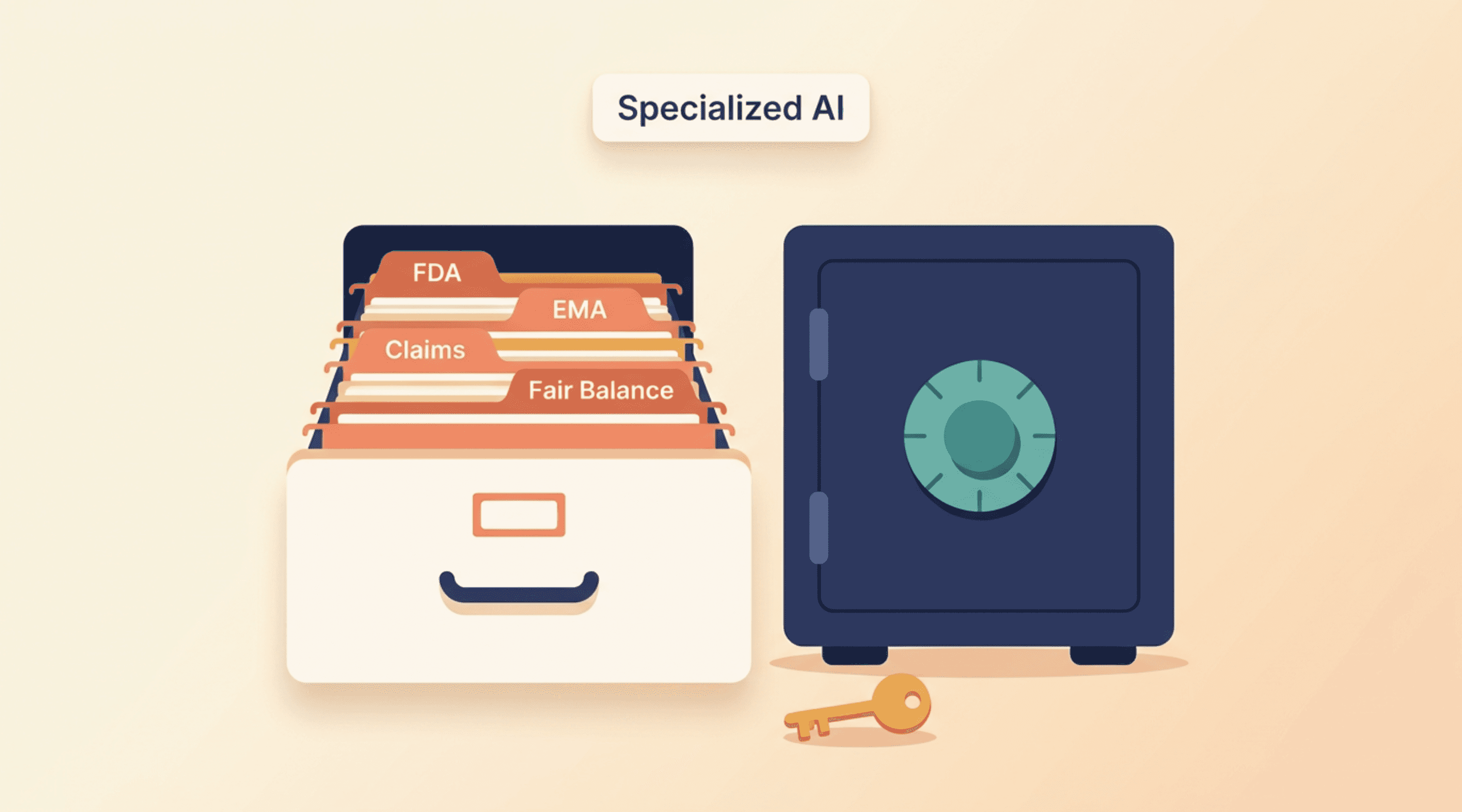
Purpose-built systems are built with regulatory frameworks embedded in their evaluation logic: FDA promotional guidance, EMA standards, regional market requirements, fair balance rules, and claim substantiation requirements. They learn from how actual MLR reviewers have flagged, approved, and revised content over time, rather than generalizing from text that merely references pharmaceutical topics.
Domain Training vs. General Capability
A general-purpose model may summarize a clinical study or draft a promotional piece, but it has no reliable framework for evaluating whether a specific claim is substantiated by the referenced data, whether fair balance disclosure is proportionate to the promotional message, or whether language meets a brand's approved claims library standards. Those tasks require precision the model was never trained to provide.
Domain-built systems assign a trained agent or module to each evaluation category: regulatory compliance, claim substantiation, fair balance, editorial and brand guidelines, and market and channel compliance. The outputs are traceable to specific rules, not probabilistic inferences. That traceability is what transforms AI assistance from an interesting capability into a defensible component of a regulated workflow.
The Risk Profile Looks Different
Using a horizontal AI tool in a pharma promotional review process introduces a category of risk that is easy to underestimate during evaluation. If the tool misses a fair balance deficiency or approves a claim lacking adequate substantiation, the downstream consequences are regulatory and operational. An inability to distinguish between a well-substantiated and a poorly-substantiated claim is not a bug that gets patched; it reflects the absence of a knowledge structure the system was never built to have.
Why Do Regulated AI Workflows Require More Than Accuracy?
Accuracy is necessary but not sufficient for regulated AI workflows in pharma. A tool can produce technically correct outputs and still be unsuitable for MLR operations if it cannot explain how it reached a conclusion, cannot be audited after the fact, and cannot demonstrate consistency across reviewers and review cycles. Regulatory bodies expect organizations to account for their review decisions, and that expectation extends to any AI system embedded in that process.
Three operational requirements consistently differentiate purpose-built solutions from horizontal alternatives in pharma MLR contexts.
Traceability at Every Decision Point
Every flag, approval, and revision recommendation generated by an AI system in a regulated environment needs to be tied to a specific rule, standard, or item in the approved claims library. When a reviewer asks why a claim was flagged, the answer cannot be that the model recommended it. It needs to reference the regulatory basis for the concern. Specialized AI produces that kind of output. General models produce probabilistic assessments that are difficult to audit and harder to defend.
Consistency Across Review Teams
Inconsistency in MLR review is itself a compliance vulnerability. When different reviewers applying the same standards reach different conclusions about the same content, it signals process gaps. AI systems that learn from a company's historical review patterns and apply them consistently across teams and therapeutic areas address this problem directly.
Auditability for Regulatory Scrutiny
The FDA's expanding attention to AI governance in drug development signals that the standard for AI accountability in life sciences is rising. Organizations embedding AI into promotional review workflows need to demonstrate that the system's outputs are traceable, its logic is consistent, and its integration with human review is clearly defined.
How Does Workflow Fit Factor Into the Specialized AI Decision?
Technology adoption in pharma operates under constraints that differ from most other industries. Switching costs are high, workflows are deeply entrenched, and any new tool that changes how teams work faces significant resistance regardless of its technical merits. This is particularly true in MLR operations, where reviewers have built review habits inside existing content management environments over many years.
Workflow fit is, in practice, a pharma AI compliance and adoption issue at the same time. A domain-specific or specialized AI tool that integrates into the environment reviewers already use is evaluated as an extension of their existing process.
Embedded vs. Standalone Deployment
The most practically important dimension of workflow fit is deployment model. AI systems that embed directly into existing content management platforms require no behavioral change from reviewers: the analysis happens in the environment where review already occurs, outputs appear in familiar interfaces, and the human reviewer remains in control of every final decision. Standalone platforms offer more control over the end-to-end content lifecycle, which suits teams that operate their own review workflow.

Human-in-the-Loop Architecture
Both deployment models, when properly designed, maintain human reviewers as the final decision-makers. Purpose-built AI surfaces issues and accelerates review by pre-screening content across the five MLR categories before it reaches a human reviewer. This is different from autonomous review. Reviewers handle more content at higher quality, without any reduction in human authority over final decisions. That distinction matters operationally and is worth communicating clearly to internal stakeholders who may have concerns about AI's role in compliance-sensitive processes.
Specialized AI vs. General AI: A Comparison for Pharma MLR Teams
The table below maps common evaluation criteria for AI in pharma MLR operations against what purpose-built and general-purpose tools typically deliver.
Evaluation Criterion | Specialized AI | General-Purpose AI |
|---|---|---|
Regulatory training depth | Trained on FDA/EMA frameworks, claim substantiation standards, fair balance rules | General text training; may reference regulatory topics but lacks rule logic |
Decision traceability | Flags tied to specific rules, standards, or approved claims | Probabilistic scoring; difficult to audit or defend to regulators |
Review consistency | Learns from historical review patterns; applies consistently across teams | No institutional memory; outputs vary by prompt and context |
Workflow integration | Embeds in existing CMS or provides purpose-built MLR workspace | Requires content to move into a general-purpose interface |
Human-in-the-loop design | Architected to support human reviewer decision-making at every step | Variable; depends on implementation choice |
Onboarding complexity | Built for pharma; accepts existing file formats, fast deployment | Requires significant prompt engineering and workflow customization |
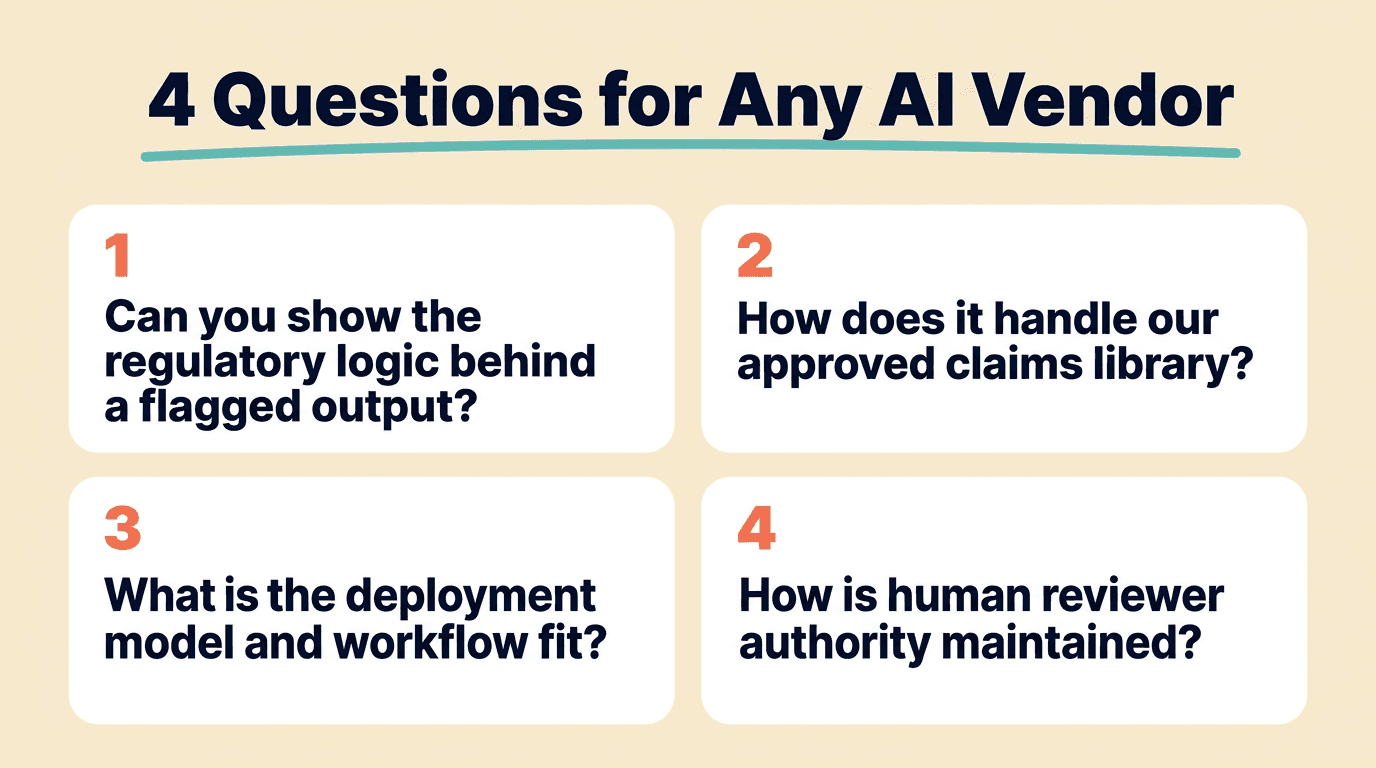
4 Questions to Ask Any AI Vendor Before Deploying in a Regulated Workflow
These four questions are designed to surface the difference between domain-built and general-purpose capabilities quickly, before a procurement decision is made.
Can you show us the regulatory logic behind a flagged output? A purpose-built system should be able to show, for any flag it generates, which regulatory standard, claim substantiation requirement, or fair balance rule triggered the review. If a vendor cannot demonstrate rule-level traceability, that is a meaningful gap for regulated AI workflows.
How does the system handle our existing approved claims library? Pharma AI compliance depends in part on ensuring promotional content references only approved, substantiated claims. Ask whether the AI can ingest and learn from existing approved materials and whether claim-level cross-referencing is built into the review logic.
What is the deployment model, and how does it fit our current review environment? Whether a team needs AI embedded within their existing content management platform or a standalone workspace affects adoption far more than technical capability differences alone. Vendors should support both models and explain clearly how each operates.
How does the system maintain human reviewer authority over final decisions? The AI's role should be clearly defined as supporting the human reviewer, not replacing that judgment. Vendors should describe exactly where AI output ends and human decision-making begins, and demonstrate that the architecture enforces that boundary consistently.
FAQ
Can a general-purpose model be fine-tuned to handle pharma MLR review?
Fine-tuning can improve performance on specific tasks, but it does not resolve deeper architectural issues: lack of rule-level traceability, no integration with regulatory frameworks as living standards, and no mechanism for learning from a company's own historical review decisions. Organizations that have attempted this typically find the customization burden substantial and the results difficult to audit consistently.
How does specialized AI keep pace with updates to FDA or regional regulatory requirements?
Purpose-built platforms for pharma MLR review are maintained by teams with pharmaceutical regulatory expertise, which means regulatory framework updates are incorporated into the system's logic as part of ongoing maintenance. General-purpose tools have no structured process for this, because regulatory specificity was never part of their design. For life sciences operators, that ongoing maintenance is a meaningful part of the value delivered by a domain-focused vendor.
What does human-in-the-loop mean in practice for MLR review?
It means the AI pre-screens content across review categories and surfaces potential issues before the content reaches a human reviewer, rather than approving or rejecting materials autonomously. Every final review decision remains with a qualified human. The AI compresses the time required by pre-surfacing issues that would otherwise require manual cross-referencing across regulatory standards, claim libraries, and brand guidelines.
Does adopting domain-built AI require replacing existing content management infrastructure?
Not necessarily. Purpose-built AI for pharma MLR review is available in deployment models that embed directly within existing content management environments, so reviewers continue working in the interface they already know. Organizations that prefer a dedicated review workspace can deploy a standalone platform.
The Right AI for Regulated Pharma Is Built for It
The general vs. specialized AI question in life sciences ultimately comes down to risk tolerance and regulatory accountability. General-purpose tools are built for breadth; they perform well across tasks that reward fluency and general reasoning. Regulated AI workflows in pharma reward something different: precision, traceability, domain depth, and the ability to embed within a compliance process that will face regulatory scrutiny.
The five categories of MLR review, regulatory compliance, claim substantiation, fair balance, editorial standards, and market and channel compliance, are not tasks a generic model addresses reliably. They require a system purpose-built to understand them, trained on materials that reflect them, and architected to produce outputs a human reviewer can act on and a regulator can audit.
For life sciences organizations evaluating AI for their promotional review process, Revisto provides specialized AI built for pharmaceutical MLR operations, covering all five review categories with full traceability and flexible deployment that fits the way your team already works. Connect with our team to see how it fits your workflow.