
Key TakeawaysChoosing an MLR review solution is less about picking a product and more about choosing among three distinct buying motions, each with a different cost, integration, and switching profile.
Total cost of ownership and switching cost, not feature lists alone, separate a shortlist that fits from one that stalls in procurement. |
|---|
Selecting an MLR review solution has become a higher-stakes decision than it was even two years ago. Promotional material production rose 29 percent year over year in the United States, according to recent industry benchmarks, while reviewer headcount has stayed flat. At the same time, the regulatory environment has tightened. For buyers consolidating a shortlist, the question is no longer whether to invest in promotional review tooling, but which category of tooling matches the team, the existing systems, and the budget. More on how Revisto approaches MLR review comes later; this guide is structured to help a buyer compare options on their own terms first.
This buyer's guide breaks the market into three buying motions rather than a list of named products. Each motion fits a different organizational starting point, carries a different total cost of ownership, and imposes a different switching cost. Reading the market this way makes it easier to see why two pharmaceutical teams evaluating the same query, website MLR review among them, can reasonably arrive at very different choices. The goal is a framework that maps cleanly onto the way procurement, regulatory affairs, and marketing operations actually evaluate a purchase.
What Are the Three Ways to Buy an MLR Review Solution?
Most promotional review purchases fall into one of three buying motions. The first treats review as a workflow problem and reaches for general routing tools. The second treats it as a dedicated software problem and reaches for purpose-built review platforms. The third treats it as a compliance intelligence problem and adds an AI review layer to the systems already in place. Understanding which problem a team is actually solving is the first step in narrowing a shortlist.
It helps to separate three layers that are often conflated. A content management system, such as a digital asset manager or a promotional content repository, is the system of record: it handles file storage, routing, version control, and approval capture. A generic AI review tool applies general-purpose language checks for spelling, grammar, and basic editorial consistency, with no pharmaceutical specialization. A specialized pharmaceutical MLR review software layer applies compliance intelligence across the full set of promotional review categories. These layers are complementary, not interchangeable, and a sound evaluation keeps them distinct.
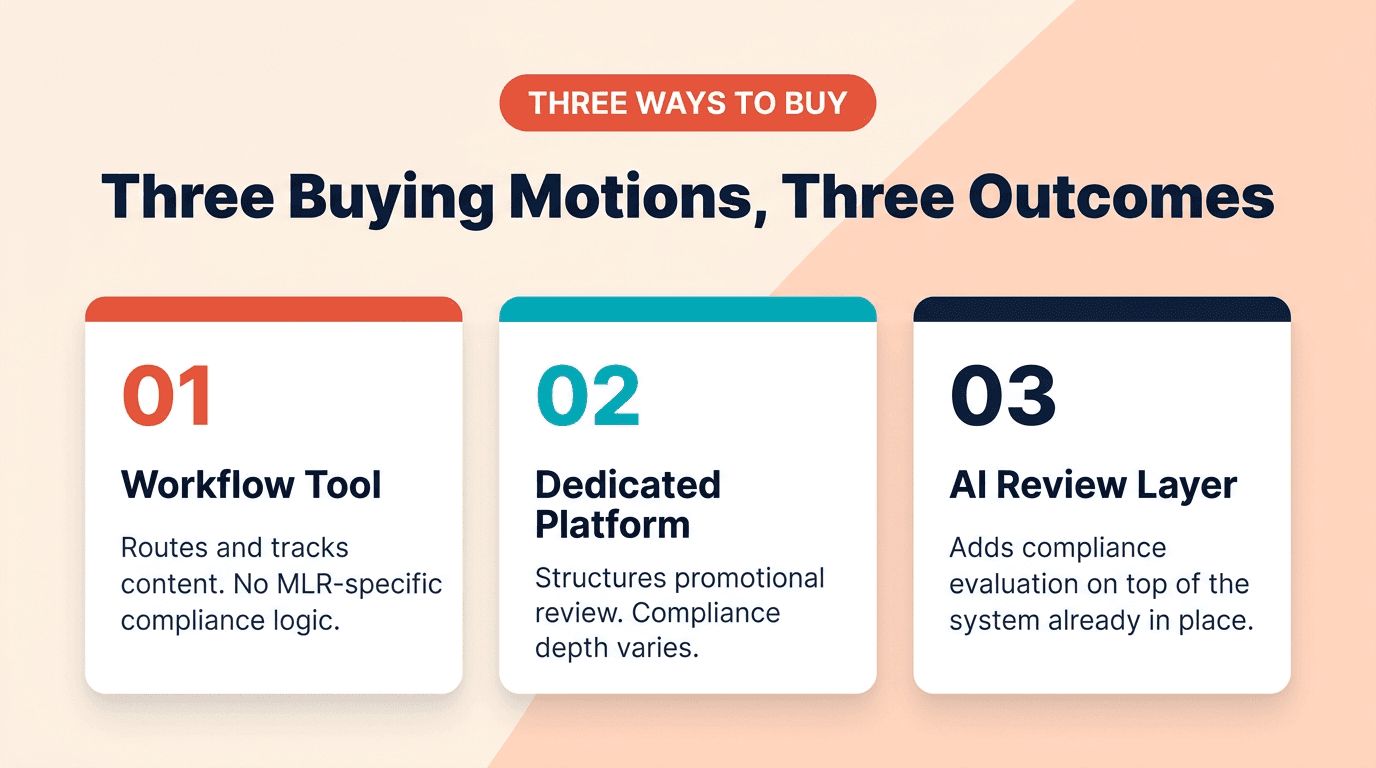
Buying Motion One: The Workflow Tool
A workflow tool organizes the movement of content through review. Digital asset managers and project management platforms route assets to reviewers, track versions, and record sign-offs. They give marketing operations visibility into where an asset sits in the queue and who has acted on it. For teams whose primary gap is coordination rather than compliance judgment, this can be a reasonable starting point.
The limitation is scope. A workflow tool moves content and records decisions, but it does not evaluate whether a claim is substantiated or whether risk information is fairly balanced. The compliance judgment still rests entirely with human reviewers, and the tool offers no support in surfacing issues before they reach the reviewer's desk. As content volume grows, coordination improves while the review burden itself stays where it was. For a team whose reviewers are already at capacity, better routing alone does little to relieve the pressure that prompted the search in the first place.
Buying Motion Two: The Dedicated Review Platform
A dedicated review platform is purpose-built for promotional review. Often marketed as MLR review software, this category adds structure that general workflow tools lack: review stage definitions, annotation tools designed for regulatory comments, audit trails built to withstand scrutiny, and templates aligned to promotional review committee practice. For teams that have outgrown email threads and shared drives, this category brings discipline to the process.
Compliance depth varies considerably within this category. Some MLR review software focuses on routing and record-keeping with limited automated checking, while others layer in claim libraries and reference management. Buyers evaluating this motion should look closely at what the platform actually checks automatically versus what it simply organizes for a human to check. The distinction between organizing review and evaluating content is where total cost of ownership often hides.
It is also worth separating the dedicated platform from the broader category some buyers search for as a pharma compliance platform. That phrase often points to enterprise compliance suites governing far more than promotional review, including quality, safety, and submissions. Promotional review is one workflow within that wider landscape, and treating the two as the same thing leads buyers to evaluate the wrong feature set for the problem at hand.
Buying Motion Three: The AI Review Layer on the Existing Stack
The third motion adds a specialized AI review layer on top of the content management system a team already uses. Rather than replacing the system of record, this approach introduces compliance evaluation into the existing workflow. Reviewers continue to work where they already work, and the AI surfaces potential issues across promotional review categories before the human review begins. Humans still make every final call; the layer accelerates and sharpens their work rather than substituting for it.
This motion suits teams that are already committed to a content management platform and are reluctant to retrain working patterns or migrate years of approved materials. Because it sits on top of the existing stack, the switching cost is structurally lower than a full platform migration. For a deeper look at why specialization matters here, see this discussion of general versus specialized AI in regulated review settings.
An AI review layer also tends to bring value before formal review even begins, by helping build and maintain a library of approved claims. Reviewers can reference validated language rather than reconstruct it each cycle, which reduces the back-and-forth that drives revision loops. The shift away from manually maintained claims libraries is one of the clearer markers that separates AI MLR software.
The table below summarizes how the three motions compare on the dimensions buyers weigh most.
Dimension | Workflow Tool | Dedicated Review Platform | AI Review Layer |
|---|---|---|---|
Primary function | Routing, version control, sign-off capture | Structured promotional review and audit trail | Compliance evaluation across review categories |
MLR-specific logic | None | Varies by platform | Purpose-built for promotional review |
Relationship to system of record | May be the system of record | Often replaces existing system | Works alongside existing systems |
Typical switching cost | Low to moderate | High (migration and retraining) | Low (adds to current workflow) |
Best fit | Teams needing coordination only | Teams without a review platform in place | Teams to optimizing the review and evaluation steps |
How Do Total Cost of Ownership and Switching Cost Differ?
Sticker price is the least useful number in a promotional review purchase. The figures that move the decision are total cost of ownership over several years and the one-time switching cost of moving from the current state to the new one. Both vary sharply across the three buying motions, and both are frequently underestimated during early vendor conversations. A procurement team that anchors on license cost alone will often discover the real spend only after implementation begins, when the integration and training line items arrive.
Total cost of ownership extends well beyond licensing. It includes implementation, data migration, integration engineering, ongoing administration, reviewer training, and the productivity dip that accompanies any process change. Switching cost is the portion of that total concentrated at the transition: migrating approved materials, rebuilding claim references, reconfiguring routing, and bringing reviewers up to speed. For organizations heavily invested in an existing content management platform, switching cost can dominate the analysis, which is part of why tooling that fits the existing process tends to realize value faster.

Where the Hidden Costs Accumulate
The costs that surprise buyers are rarely on the quote. Revision cycles that loop repeatedly, reviewer time spent reconciling versions, and rework triggered late in the process all carry real expense that a feature comparison will not reveal. A closer look at the hidden costs of MLR revisions shows how these compounding cycles can outweigh the headline license fee. Buyers should ask each option how it reduces revision loops, not only how it routes them.
Integration engineering is another cost that lands unevenly. A solution that connects cleanly to the existing content management system and identity provider requires far less custom work than one that demands a parallel environment.
Reading Switching Cost Honestly
Switching cost is highest when a purchase requires abandoning a system the organization already depends on. Migrating an established content repository means moving historical assets, preserving audit history, and retraining reviewers on a new interface, all while live work continues. A solution that adds capability to the current system avoids most of this, which is why the AI review layer motion typically carries the lowest switching cost of the three. Where a row in a comparison would naturally produce a winner on switching cost alone, the honest answer often depends on how committed the team already is to its current platform.
The regulatory backdrop raises the stakes on getting this calculation right. A year-in-review of FDA enforcement found that the agency issued more than 200 letters challenging pharmaceutical advertising and promotion in 2025, the highest annual total in nearly 25 years, alongside its own use of technology-enabled surveillance. In that environment, a tool that helps demonstrate that every external claim traces to an authorized source addresses a governance need, not only a speed one. Buyers weighing switching cost should factor in the cost of not improving traceability, which is harder to quantify but increasingly material.
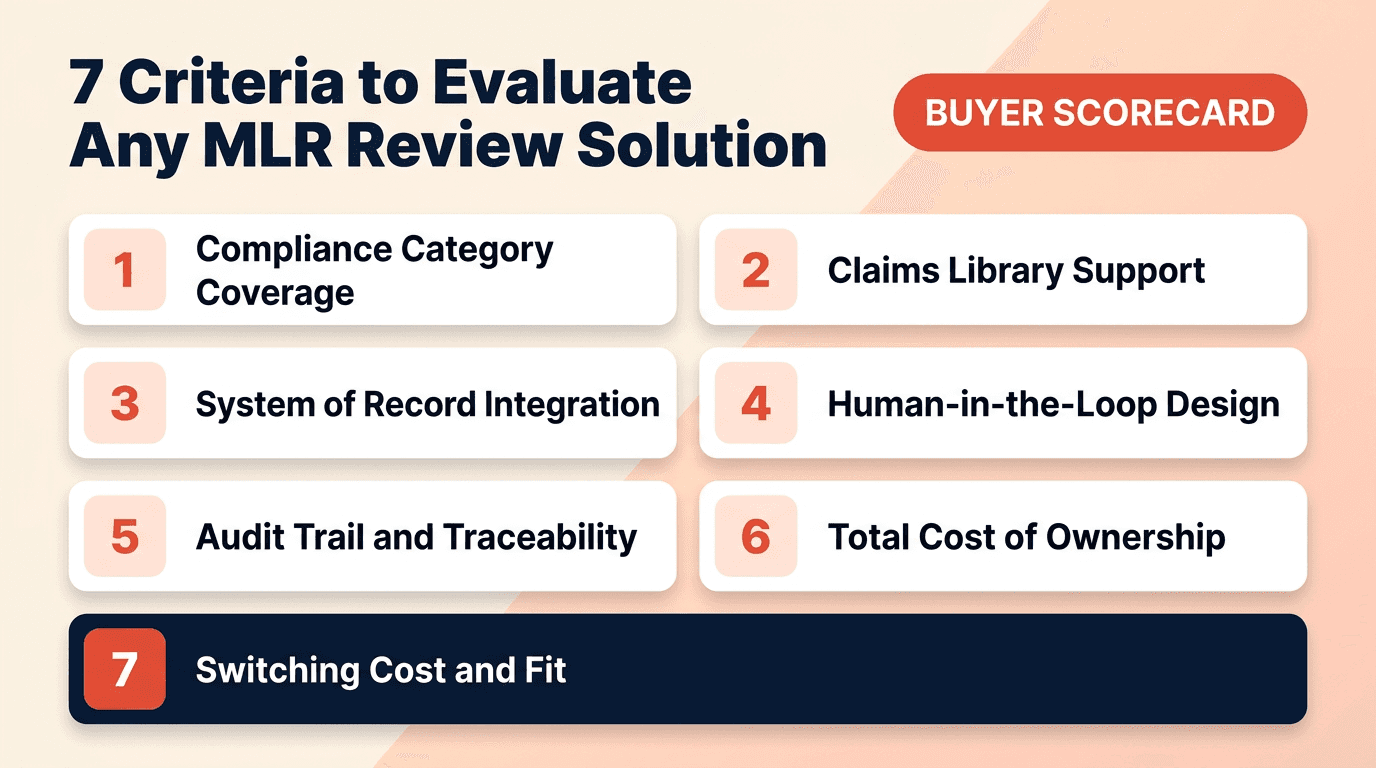
7 Criteria to Evaluate Any MLR Review Solution
Once a team has identified which buying motion fits, the following criteria help compare specific options within and across motions. Each applies whether the candidate is a workflow tool, a dedicated platform, or an AI review layer. Treating them as a weighted scorecard, rather than a checklist where every item counts equally, keeps the evaluation anchored to what matters most for the specific team.
Compliance category coverage. Confirm which promotional review categories the option evaluates automatically, including regulatory compliance, claim substantiation, fair balance, editorial and brand consistency, and market or channel rules. Coverage across all of these is meaningfully different from coverage of one or two.
Claims library support. Evaluate how the option helps build and maintain a searchable library of approved claims extracted from existing materials, so reviewers can reference validated language rather than reconstruct it each cycle.
Integration with the system of record. Assess how the option connects to the content management platform, identity provider, and any submission environment already in use, and whether those connections are standard or require custom engineering.
Human-in-the-loop design. Verify that the option supports reviewers rather than displacing them, surfacing issues for human judgment and keeping final approval decisions with the medical, legal, and regulatory reviewers who own them.
Audit trail and traceability. Check that every claim can be traced to an authorized source and that decisions are recorded in a defensible trail, which matters more as regulators expand their own technology-enabled surveillance.
Total cost of ownership. Model the multi-year cost including implementation, integration, training, and administration, alongside the productivity effect of changing the review process.
Switching cost and fit. Weigh what the team gives up to adopt the option against what it gains, accounting for how committed the organization already is to its current content management platform.
What Integration Factors Should Buyers Weigh?
Integration is where many promotional review purchases succeed or stall. A solution that fits the existing technical environment reaches value quickly, while one that requires a parallel environment or heavy custom engineering can stretch a three-month evaluation into a year-long project. Three integration questions matter most for pharmaceutical and life sciences buyers.
Content Management and Document Systems
Most pharmaceutical teams route promotional content through an established content management platform. The central integration question is whether a candidate works alongside that system or asks the team to leave it. An option that embeds into the existing environment lets reviewers stay in a familiar interface, which tends to drive higher adoption. Anything that pulls reviewers out of their established workflow typically meets resistance, which is why modern promotional review tooling increasingly emphasizes fitting the existing process over forcing a redesign.
Generative AI and Content Production
As teams adopt generative tools to produce content faster, the volume entering review climbs and so does the compliance risk specific to generated material. Generated drafts can introduce claims that read fluently but lack an authorized source, which makes consistent evaluation more important, not less. The integration consideration here is whether MLR review software can evaluate content regardless of how it was produced, applying consistent compliance checks to both human-written and AI-assisted drafts. The review layer and the production tools serve different purposes, and a clean separation between producing content and evaluating it for compliance keeps accountability clear.
Identity, Access, and the Audit Trail
Single sign-on, role-based access, and a defensible audit trail are baseline expectations in regulated environments. Buyers should confirm that a candidate integrates with the organization's identity provider and preserves a complete record of who reviewed what and when. These connections are easy to overlook in a feature demo and expensive to retrofit later, so they belong on the evaluation checklist from the start.
Frequently Asked Questions
What is an MLR review solution?
An MLR review solution is software that supports the medical, legal, and regulatory review of pharmaceutical promotional content. Depending on the category, it may route content through review, structure the promotional review process, or apply automated compliance evaluation across review categories. The strongest options combine support for reviewers with a defensible audit trail while leaving final decisions to human experts.
How is a website MLR review different from reviewing other content?
A website MLR review applies the same medical, legal, and regulatory standards as other promotional content, but adds considerations specific to digital formats. Reviewers assess linked claims, interactive elements, fair balance across pages, and how risk information is presented on screen. Because web content updates frequently, a solution that supports repeatable review of recurring elements reduces the burden of re-reviewing pages that change incrementally.
Does adopting an MLR review solution mean replacing reviewers?
No. A sound platform is designed to support reviewers, not replace them. The technology surfaces potential issues and accelerates the review, while medical, legal, and regulatory experts retain every final approval decision. This human-in-the-loop model is what allows teams to handle more content at higher quality without lowering the bar on compliance.
How long does it take to see value from a new solution?
Time to value depends heavily on the buying motion and the integration required. Options that work alongside the existing content management system tend to reach value faster because they avoid migration and reviewer retraining, while full platform replacements take longer as historical assets move and teams adapt to a new interface. Buyers should ask each candidate for a realistic timeline based on their specific stack rather than a generic estimate.
Choosing the Path That Fits Your Team
The right platform is the one that matches a team's existing systems, content volume, and tolerance for change, not simply the one with the longest feature list. Mapping the market into three buying motions, then comparing options on total cost of ownership and switching cost, turns an overwhelming vendor landscape into a manageable shortlist. The teams that buy well are the ones that understand which problem they are actually solving before they start evaluating products.
For teams already committed to a content management platform that want compliance depth without a disruptive migration, Revisto provides an AI review layer that works alongside existing systems and supports reviewers across all promotional review categories. Request a demo to see how it fits your current workflow.