
Key Takeaways Not all MLR review software addresses the same problems — the features that determine ROI are claims traceability, audit trail integrity, fair balance enforcement, and native integration with existing content management systems.
If your current review platform cannot trace every claim to its source and surface fair balance gaps automatically, it is not a compliance solution. It is a workflow tool with a compliance label. |
|---|
The global market for MLR review software is projected to reach $28.6 billion by 2030, growing at a compound annual rate of nearly 10%. Pharmaceutical and life sciences marketing teams are producing more content across more channels than ever, while the regulatory environment has grown more unforgiving, not less. The FDA's Office of Prescription Drug Promotion intensified enforcement focus in 2025 on substantiation, fair balance, and accurate risk disclosure, and there is every indication that scrutiny will remain high in 2026 and beyond. For pharma teams evaluating MLR review software, the decision is less about finding a platform with a long feature list and more about determining which capabilities actually close the compliance gaps that matter.
This is a bottom-funnel comparison for teams that have already decided to move beyond manual review and are now assessing which promotional review software can handle the full scope of what MLR demands. Four capabilities separate comprehensive solutions from partial ones: claims traceability, audit trail documentation, automated fair balance enforcement, and native CMS compatibility. The following breaks down each one, covering what it requires technically, why it matters operationally, and what to look for when evaluating any MLR review solution.
Why Is Claims Traceability the Core of Any Serious MLR Tool?
Of all the capabilities that distinguish enterprise-grade MLR software from lighter workflow tools, claims traceability is the one teams most consistently underestimate at the point of purchase, and most regret underinvesting in once they are in production. Claims substantiation consumes the majority of MLR review effort. Without automated traceability, it is also the source of the majority of review cycle delays.
What Claims Traceability Actually Requires
Claims traceability means that every promotional claim, whether in a detailed aid, a patient brochure, a digital ad, or a sales leave-behind, can be linked directly back to its source: an approved clinical publication, a regulatory filing, or a validated claims library. The substantiation must be current, accessible, and auditable. Effective review platforms should automate this process by analyzing the promotional material against a library of approved references and flagging any claim that lacks a traceable, adequate source.
Beyond individual claim validation, robust MLR review software should also maintain a dynamic claims library that continuously learns from approved materials, so that validated claims are available for reuse without re-substantiation. This eliminates the duplicate effort that consumes pharma reviewers' time across brands and asset types. Claims that are already validated surface immediately, rather than requiring writers and reviewers to start from scratch on every asset.

Why Inadequate Claims Tools Are a Compliance Liability
According to FDA regulatory guidance, promotional claims must be substantiated by adequate scientific evidence, and that substantiation must be documented. When a team cannot trace a claim to its source quickly and definitively, the risk extends beyond a slow review cycle. The real exposure is approving content that would not survive an FDA inquiry.
The volume problem compounds this. As digital marketing expands, life sciences teams are producing significantly more assets per brand, per launch, per quarter than they were five years ago. Any review platform that requires manual claims substantiation, or that only partially automates it, cannot keep pace with that volume without increasing review staff proportionally. That is not a scalable compliance model.
Claims Traceability Capability | Manual / Basic MLR Tool | AI-Driven MLR Review Software |
|---|---|---|
Claim-to-source linking | Manual lookup, reviewer-dependent | Automated against clinical library |
Claims library | Static or nonexistent | Dynamic, searchable, continuously updated |
Reuse across brands | Copy-paste, high error risk | Structured reuse with validation |
Substantiation documentation | Inconsistent, file-based | Embedded in review record, audit-ready |
Scalability across content volume | Breaks down at scale | Scales with content production |
What Should a Complete Audit Trail Look Like in MLR Software?
The audit trail is the institutional memory of the promotional review process. Every decision made, every comment added, every version approved or rejected needs to be documented in a way that is timestamped, reviewer-attributed, and retrievable. For pharma companies, that documentation burden is not a best practice item to check off; it is a genuine compliance obligation outlined in FDA guidance. As the regulatory environment has tightened, the ability to reconstruct the full history of a promotional material's review, including who flagged what, what was changed, and who gave final approval, has shifted from a compliance advantage to a compliance requirement.
The Components of an Audit-Ready Review Record
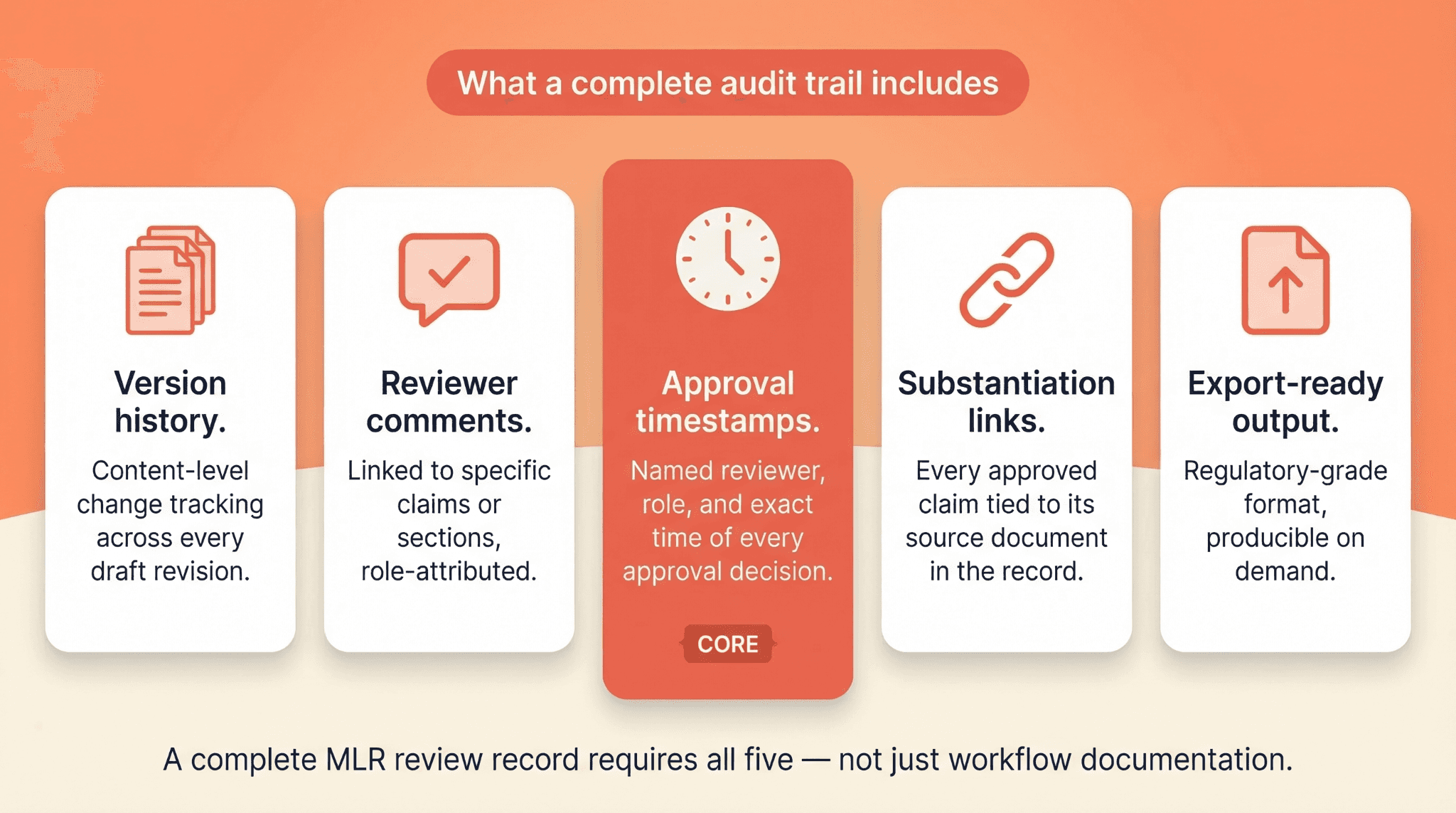
At minimum, a complete audit trail in any serious promotional review software should include: version history with changes tracked at the content level; reviewer comments linked to specific claims or sections; approval timestamps with named reviewers; and a final record that captures the substantiation supporting each approved claim. This record needs to be exportable, both for internal governance and for potential regulatory review.
There is an important distinction between workflow documentation, which tracks who touched a file and when, and compliance documentation, which ties the review record to the regulatory and scientific basis for every decision. The best platforms build both into the same interface rather than requiring teams to maintain parallel documentation systems.
Why Reviewer Accountability Matters at the Individual Decision Level
One of the persistent failure modes in pharma MLR operations is the diffusion of accountability. When review comments and approvals are distributed across email threads, shared documents, or generic project management tools, no one can reliably reconstruct who made what determination and why. Platforms that assign every action to a named reviewer, with role context (medical, legal, regulatory) and a timestamp, create the accountability structure that both internal governance and external regulators expect. They also give MLR teams meaningful data on where reviews slow down and why.
How Does Fair Balance Enforcement Work in MLR Review Software?
Fair balance is one of the most technically demanding requirements in pharmaceutical promotional review. The FDA requires that any promotional material discussing a drug's benefits must present risk information with comparable prominence: the same font size, similar placement, and equivalent emphasis. Getting this right consistently, across a high volume of diverse asset types, is something most teams struggle to do manually. It is also among the most common triggers for FDA enforcement action against pharmaceutical promotional content.
What Automated Fair Balance Checking Involves
Effective fair balance enforcement in MLR review software goes beyond flagging the presence or absence of a safety statement. It requires the system to analyze the promotional material structurally, evaluating whether benefit claims and risk disclosures are proportionally represented, whether required safety language is complete, and whether the overall presentation meets the standard of adequate disclosure. This is a nuanced analysis. It requires AI systems trained specifically on pharmaceutical promotional content and regulatory standards, not general-purpose language models.
The Relationship Between Fair Balance and Claims Substantiation
Fair balance and claims substantiation are not independent problems. A claim that is technically substantiated but not adequately balanced by corresponding risk disclosure is still a compliance failure. Any review platform that handles these as separate modules, or that addresses one but not the other, leaves gaps that reviewers have to close manually. Comprehensive solutions treat them as interconnected elements of a single review standard, which is exactly how the FDA and EMA approach them.
5 Questions to Ask When Evaluating Any Promotional Review Software
Before selecting any promotional review software, pharma or agency operations leaders should be able to get clear, documented answers to these five questions from the vendor.
Does it cover all five MLR review categories? Regulatory compliance, claims substantiation, fair balance, editorial and brand standards, and market and channel compliance. A platform that addresses three out of five still leaves manual work, and manual risk, on the table.
How does it handle claims traceability at scale? Ask for a demonstration that shows how claims are linked to source documents and what happens when a source is updated.
How does it integrate with your existing content management system? There is a meaningful difference between an integration, where data passes between systems via API, and an embedded experience, where reviewers access AI-powered analysis directly within their existing CMS interface without changing their workflow. Understand exactly which model the vendor supports.
What is the onboarding timeline and data requirement? Some platforms require significant data transformation, custom implementation, or extensive training before going live. Others accept materials as-is in standard formats (Word, PDF, Excel) and deploy within weeks. The difference in time-to-value can be significant, especially for teams that need results within a quarter.

FAQ
What is the difference between MLR AI software and a promotional review workflow tool?
A promotional review workflow tool manages the routing, assignment, and status tracking of review tasks: who has a document, where it is in the process, and whether it has been approved. MLR review software does that plus the substantive compliance work: analyzing content for regulatory violations, checking claims against approved sources, evaluating fair balance, and flagging issues before they reach a reviewer. Many teams use workflow tools and mistake them for a genuine MLR review solution; the compliance analysis capability is the critical distinction.
How does AI-powered MLR review software maintain human-in-the-loop oversight?
AI in MLR review is designed to surface issues and accelerate analysis, not to replace reviewer judgment. The AI agents run automated checks across regulatory compliance, claims substantiation, fair balance, and editorial standards, then present findings to the reviewers who make the final determination on every decision. The human reviewer sees a prioritized, pre-analyzed asset rather than a raw document, which means they spend their time on interpretation and judgment rather than mechanical screening.
How do MLR tools handle fair balance enforcement across different asset types?
Fair balance requirements vary by format. A print detail aid, a digital banner, and a patient brochure each have different layout conventions and prominence standards. Effective MLR review software applies format-aware fair balance analysis rather than a single rule set across all assets. The system needs to understand what constitutes adequate risk disclosure prominence in each context.
What should I look for in the audit trail output of an MLR review solution?
A complete audit trail should include: timestamped version history with tracked content changes; reviewer-attributed comments linked to specific sections or claims; approval records that identify the reviewer by name and role; substantiation links for every approved claim; and an exportable format suitable for regulatory review.
Choosing MLR Review Software That Covers the Full Picture
The features that matter most in MLR review software are not the ones that generate the best demo. They are the ones that close the gaps where compliance risk actually lives: claims that cannot be traced to their source, review decisions that are not properly documented, fair balance issues that slip through at scale, and workflows that get disrupted rather than supported. Teams that evaluate platforms against this checklist, covering claims traceability, audit trail integrity, fair balance enforcement, and CMS integration, will quickly identify which solutions are built for the real complexity of pharmaceutical promotional review and which are built for the sales cycle.
For teams inside Veeva Vault PromoMats looking for AI-powered analysis that does not require a workflow change, Revisto offers coverage across all five MLR review categories, including automated claims traceability, and fair balance enforcement, with a deployment model that runs directly inside your existing Veeva environment. To see how it performs on your own assets, request a demo.