
Key TakeawaysMLR review in pharma is the multi-disciplinary process that verifies every promotional claim against scientific evidence, legal standards, and regulatory requirements before a piece reaches a healthcare provider, patient, or investor.
Teams evaluating new tooling should focus on whether the platform was built specifically for promotional review work, not retrofitted from a general AI editor. |
|---|
Every promotional asset a pharmaceutical company publishes, from a sales aid to a 30-second television spot, passes through MLR review. Pharma marketing teams operate inside a structured approval process where medical, legal, and regulatory reviewers verify that claims are truthful, balanced, and substantiated before anything reaches a healthcare professional or patient. The stakes climbed sharply in September 2025, when the FDA issued a wave of enforcement letters targeting prescription drug advertising that the agency considered misleading or insufficiently supported.
This guide walks through what MLR review pharma teams actually do, how evidence-based claims substantiation works, where the bottlenecks sit, and what to look for in AI-assisted review tooling. The focus is practical rather than theoretical: how the process operates today, what regulators are scrutinizing, and how teams can compress cycle time without weakening the evidence chain. Readers looking for additional context on AI-assisted MLR review for life sciences can explore the broader category as well.
What Is MLR Review in Pharma?
So what is MLR review, in practical terms? It is the formal process by which medical, legal, and regulatory reviewers evaluate every promotional asset before it can be released. The acronym stands for medical, legal, and regulatory, sometimes referred to internally as promotional review or the promotional review committee. The purpose is to confirm that any claim made about a prescription drug is accurate, balanced, supported by evidence, and consistent with the approved product labeling.
Three reviewer functions sit at the center of the process, each with a distinct evidence standard and a distinct lens on the same content. Together they form what is sometimes called the promotional review committee.
Medical Reviewer
The medical reviewer MLR responsibility is scientific accuracy. This reviewer evaluates every clinical claim against the underlying trial data, peer-reviewed publications, and approved product labeling, then traces each piece of evidence back to its source. The medical reviewer MLR workload is the most evidence-intensive of the three because every efficacy or safety claim must be validated against a primary source. Most medical reviewers work from a structured claims library of previously approved language to avoid rebuilding the same substantiation chain on each new campaign.
Legal Reviewer
The legal reviewer evaluates promotional content against advertising law, intellectual property obligations, contract terms with co-promotion partners, and exposure to product liability. Legal reviewers focus on what the language could be construed to mean, not only what it literally says. Off-label inference, comparative claims against competitor products, and testimonial structures all draw heavy legal scrutiny.
Regulatory Reviewer
The regulatory reviewer checks alignment with FDA requirements, particularly 21 CFR Part 202 for prescription drug advertising and the fair balance requirements that pair benefit claims with appropriate risk information. Regulatory reviewers also confirm that promotional pieces meet submission requirements for Form FDA 2253 and that risk information is presented in a clear, conspicuous, and neutral manner consistent with the 2024 CCN final rule for direct-to-consumer television and radio advertising.

Why Has MLR Pharma Become Harder?
The structure of MLR pharma review has not changed dramatically over the past decade, but the volume, channel mix, and enforcement environment have. Two forces are reshaping how teams operate today.
Content Volume Outpaces Reviewer Capacity
Omnichannel marketing has multiplied the number of promotional assets per brand. A single campaign may produce dozens of channel-specific variations, each requiring its own MLR cycle. Personalization for healthcare provider segments adds another multiplier. Most internal MLR teams have not grown at the same rate as the content backlog feeding into them.
FDA Enforcement Intensified in 2025
FDA enforcement activity expanded sharply in the second half of 2025. Analysis of OPDP enforcement letters shows that the agency released nearly 100 enforcement letters in a single week in September 2025, a sharp departure from prior years when OPDP issued only a handful of letters annually. Common citations included risk minimization in direct-to-consumer television ads, unsubstantiated efficacy claims, and promotional content delivered by celebrities or executives without adequate safety disclosures.
An untitled letter from the FDA carries reputational, operational, and financial consequences, and once a sponsor receives one, future submissions for all brands typically face heightened scrutiny. What untitled letters mean and how to avoid them walks through the regulatory mechanics in more detail.
The table below summarizes how the three reviewer roles divide the work.
Reviewer Role | Primary Evaluation Focus | Evidence Source Examples |
|---|---|---|
Medical | Scientific accuracy of every clinical claim, alignment with approved labeling | Pivotal trial publications, FDA-approved label, peer-reviewed literature, internal data on file |
Legal | Advertising law exposure, comparative claim risk, IP and contract obligations | Federal and state advertising statutes, co-promotion agreements, prior settlements and consent decrees |
Regulatory | FDA compliance, fair balance, submission requirements | 21 CFR Part 202, FDA guidance documents, OPDP enforcement history, Form FDA 2253 protocols |
How Does Claims Substantiation Actually Work?
Claims substantiation is the procedural heart of the work MLR review pharma teams perform. Every assertion in a promotional piece, whether about efficacy, safety, quality of life, mechanism of action, or comparative performance, must be tied to a specific piece of supporting evidence that a reviewer can examine. The substantiation chain is what gets audited if regulators raise a question about a claim later.
Building the Evidence Chain
For each claim, the reviewer identifies the source evidence, confirms the evidence supports the specific wording used, and verifies that the claim is consistent with the approved labeling. A claim that says a drug improves outcomes is materially different from a claim that says the drug reduced a specific endpoint by a specific percentage in a specific patient population. The wording has to match what the underlying study actually demonstrated, and the population in the claim has to match the population studied.
The evidentiary bar is set by both the FTC, which requires that health-related claims be supported by competent and reliable scientific evidence, and the FDA, which expects efficacy claims about prescription drugs to be consistent with approved labeling and supported by adequate and well-controlled studies. Compressing the review schedule does not compress this underlying evidence work.
The Role of Claims Libraries
Most established pharma marketing teams maintain a claims library, a structured reference of language that has already been substantiated and approved through prior MLR cycles. When a marketing team builds a new asset using language drawn from the library, the substantiation work transfers along with the claim, dramatically compressing the time the medical reviewer needs to spend rebuilding the evidence chain. The challenge most teams face is keeping the library current, traceable, and actually searchable for writers who are starting a new campaign. Solutions for MLR pharma workflows covers this in more detail.
Fair Balance and Risk Presentation
Claims substantiation is closely tied to fair balance. A promotional piece that accurately substantiates an efficacy claim can still trigger an enforcement letter if the corresponding risk information is minimized, omitted, or presented in a way that competes with the benefit messaging. Regulators have made clear that visual presentation, audio modality, and pacing all factor into whether risk information is considered clear, conspicuous, and neutral.
Five Things to Look For in AI-Assisted MLR Review Pharma Tooling
Teams evaluating AI tooling for MLR pharma review encounter a wide range of options, from general-purpose AI editors retrofitted with compliance prompts to platforms purpose-built for promotional review. The list below covers what to scrutinize most closely.
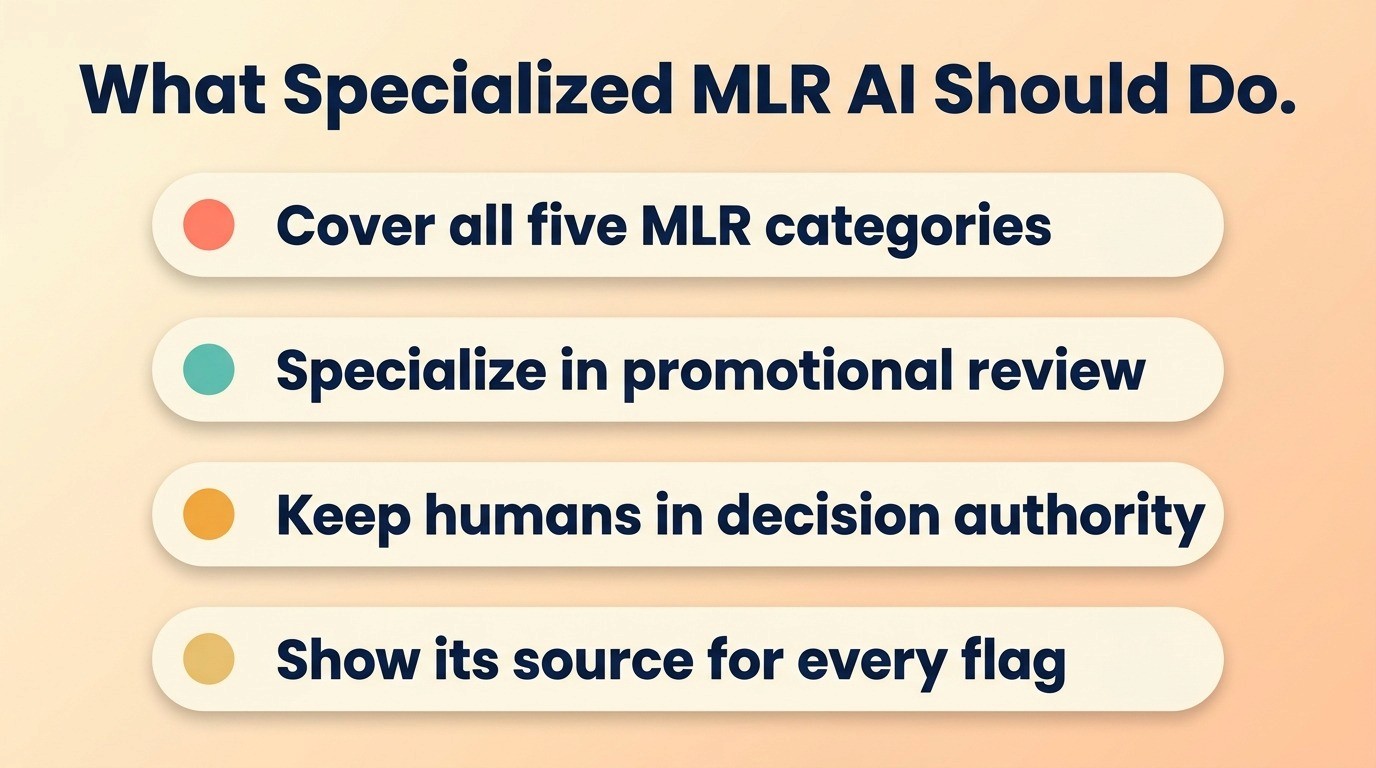
Coverage across all five MLR categories. Promotional review involves regulatory compliance, claim substantiation, fair balance, editorial and brand consistency, and market or channel-specific requirements. Look for AI tooling that evaluates content against all five categories rather than addressing only spelling, grammar, or surface-level editorial issues.
Specialization in pharma promotional review. Specialized AI built for promotional review work understands what claims substantiation means, why fair balance pairing matters, and what counts as off-label inference. Generic AI tooling can flag editorial issues but typically cannot evaluate regulatory risk with the depth that medical reviewer MLR work requires.
Human-in-the-loop architecture. AI should surface issues, suggest substantiation sources, and accelerate evidence review. Human reviewers retain decision authority on every approval. Tools that frame themselves as autonomous reviewers should be evaluated cautiously against the FDA expectation that promotional claims are the responsibility of the sponsor and its qualified reviewers.
Integration with existing systems. Most pharma teams already use a content management platform of record for routing, version control, and approval capture. AI review tooling should work alongside this system rather than asking teams to migrate years of approval history. Platforms that support both embedded and standalone deployment can accommodate teams at different stages of CMS adoption.
Traceability of every AI recommendation. When AI flags a claim as unsubstantiated or recommends a specific piece of supporting evidence, reviewers need to see the source the recommendation is based on. Traceability is what makes AI-assisted review defensible during internal QA and during any subsequent regulatory inquiry.
Frequently Asked Questions
What is MLR review and who is involved?
MLR review is the multi-disciplinary process of evaluating pharmaceutical promotional content for medical accuracy, legal exposure, and regulatory compliance before publication. Three reviewer roles participate: a medical reviewer who validates clinical claims against scientific evidence, a legal reviewer who evaluates advertising law and IP exposure, and a regulatory reviewer who confirms FDA compliance. Marketing teams, agency partners, and MLR coordinators support the process by preparing materials, routing review cycles, and tracking approvals.
How long does MLR review pharma typically take?
Standard MLR review cycles for prescription drug promotional materials commonly run several weeks per asset, with complex pieces sometimes extending to two or three months. The actual duration depends on asset complexity, claim density, prior substantiation history, and reviewer availability. Multi-round revisions are common when claims require new substantiation or when fair balance pairing needs adjustment.
What is claims substantiation in pharma promotional review?
Claims substantiation is the practice of tying every promotional assertion to specific supporting evidence, typically a clinical study, the approved product label, or another authoritative source. The substantiation chain must demonstrate that the specific wording used is supported by the specific evidence cited, including alignment of patient population, endpoint, and effect size. Claims substantiation is the most evidence-intensive component of MLR pharma review and is the primary focus of the medical reviewer.
How does AI fit into MLR pharma review?
AI-assisted MLR review evaluates promotional content against regulatory requirements, approved claims libraries, and fair balance standards, surfacing issues for human reviewers to evaluate. Specialized AI built for promotional review can identify potentially unsubstantiated claims, compare new content against previously approved language, and flag fair balance gaps. Human reviewers retain final approval authority; the AI accelerates evidence-checking work but does not replace clinical, legal, or regulatory judgment.
What triggers an FDA untitled letter?
Untitled letters from the FDA Office of Prescription Drug Promotion typically cite promotional materials that omit or minimize risk information, make unsubstantiated efficacy claims, present comparative claims without adequate support, or fail to present required risk information in a clear, conspicuous, and neutral manner. The 2025 enforcement wave focused particularly on direct-to-consumer television advertising, social media content, and promotional appearances by celebrities or executives.
Closing the Gap Between Volume and Capacity
MLR review pharma operations sit at the intersection of regulatory accountability and commercial pressure. Content volume is rising, enforcement is intensifying, and the evidentiary standards that anchor claims substantiation have not relaxed. The teams that move fastest without taking on additional regulatory risk are the ones that have invested in structure: a current claims library, clear stage-level cycle time targets, and AI tooling that augments evidence review rather than substituting for it.
Revisto builds AI specifically for the MLR review pharma context, with coverage across all five review categories and deployment options that work alongside existing content management systems. Revisto Studio provides a standalone AI workspace for life sciences marketing and MLR teams. Request a demo to see how it fits your review process.