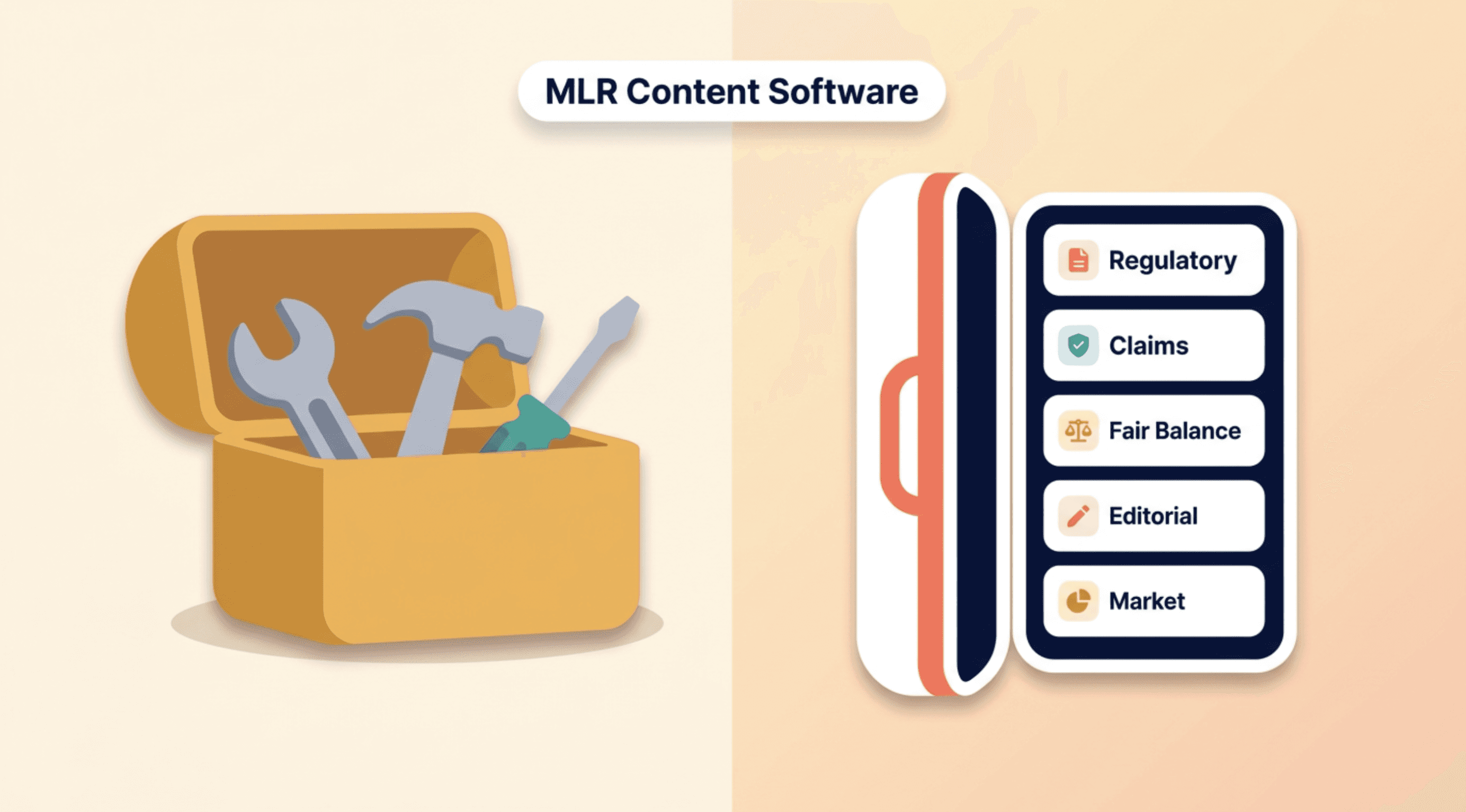
Key TakeawaysContent management systems route files and capture approvals, but the AI layer that evaluates pharma promotional content for compliance is a separate category, and not all AI review tools are built for it.
The right MLR content software adds compliance intelligence to the review workflow. It surfaces risks before reviewers start their work. |
|---|
Pharmaceutical promotional materials are not ordinary marketing assets. Every claim, every disclosure, every framing choice carries regulatory weight, and the consequences of getting it wrong range from FDA enforcement letters to delayed product launches to damaged brand credibility. That stakes environment is why MLR content software purpose-built for life sciences exists as a distinct category from the general-purpose AI review tools that work in other industries.
The distinction worth understanding is between three different layers of the review stack. Content management systems handle the file infrastructure: routing, version control, audit trail, and approval capture. Generic AI review tools layer in basic content checks like spelling, grammar, and editorial review. Specialized pharma MLR AI review software adds compliance intelligence specific to life sciences: claims substantiation, fair balance evaluation, regulatory alignment, and channel-specific compliance. Specialized AI in the pharmaceutical industry is increasingly the standard for that compliance layer, and the distinction matters more as content volume scales.
This article breaks down what separates pharma-specific MLR AI review software from generic alternatives, what compliance capabilities regulated teams actually need from the AI layer, and what to look for when evaluating promotional review solutions for a pharma or life sciences organization.
What Does MLR Content Software Actually Need to Do?
The term "review software" covers a wide range of functionality, and that breadth creates real evaluation risk. A content management system can be excellent at managing file versions and routing approvals while having no compliance intelligence at all. A generic AI review tool can run spelling, grammar, and basic editorial checks while having no awareness of FDA promotional standards. Specialized pharma MLR AI review software is the layer that evaluates content against the compliance requirements regulated teams actually face.
Pharma promotional review is governed by the FDA's Office of Prescription Drug Promotion (OPDP), which requires that promotional materials be truthful, balanced, and non-misleading. That means every asset must present an accurate risk-benefit relationship, substantiate all efficacy claims with valid scientific evidence, and meet channel-specific standards for disclosures. These are not file management requirements. They are compliance requirements that demand domain-specific knowledge baked into the AI layer itself.
Claims Library Building: Where Compliance Foundations Are Set
One of the most underappreciated factors in pharma promotional review is the quality of the claims library that sits upstream of it. When marketing teams draft assets without access to a centralized library of pre-approved language, claims often get written from memory, recycled from outdated materials, or built from sources that have not been validated against the current approved set for a given brand. The result is a steady inflow of compliance issues that reviewers then have to catch and correct downstream.
Specialized MLR AI review software addresses this layer by automating claims library construction. AI-powered claims extraction can pull approved language from existing materials, organize it by brand and indication, and make it searchable so that writers and reviewers can reference validated claims rather than rebuilding the library by hand each time. The result is fewer compliance gaps entering formal review, which compresses revision cycles meaningfully.
The efficiency gains compound across the review function. Teams that have looked at manual claims library limitations find that the quality of the claims library is inseparable from the speed and quality of formal MLR review.
Compliance Screening: The Layer Generic AI Review Tools Skip
Once content is drafted and ready for review, it needs active compliance screening before it reaches the MLR reviewers. This is where specialized pharma MLR AI review software is differentiated from generic AI review tools.
Compliance screening requires evaluating content against regulatory standards, approved claims, fair balance requirements, editorial guidelines, and market-specific channel rules simultaneously. That evaluation requires the kind of domain knowledge that general-purpose AI platforms were not built around.
The FDA's OPDP reviews promotional materials for fair balance, substantiation, and accurate risk representation. Achieving that in practice means reviewers need to evaluate five distinct compliance categories on every asset: regulatory compliance, claim substantiation, fair balance, editorial and brand standards, and market and channel compliance. Generic AI review tools that handle spelling, grammar, and editorial pass-throughs do not apply these compliance categories. They are useful for creative asset review in non-regulated contexts, and they sit at a different layer of the review stack than the compliance evaluation pharma promotional materials require.
AI Review Capability | Generic AI Review Tools | Specialized Pharma MLR AI Review Software |
|---|---|---|
Spelling, grammar, and editorial check | Yes | Yes |
Claims substantiation screening | No | Yes |
Fair balance evaluation | No | Yes |
Regulatory compliance checks (FDA/EMA) | No | Yes |
Channel and market compliance rules | No | Yes |
AI-powered claims library extraction | No | Yes |
Designed to operate alongside an existing CMS | Sometimes | Yes |

Where Does the AI Review Layer Sit in the Pharma Content Stack?
Specialized pharma MLR AI review software is most useful when it operates inside the systems reviewers are already using. Life sciences organizations have significant operational investment in content management platforms, and any AI tool that requires teams to leave that environment introduces friction that increases with organization size.
Two architectural patterns address this. In an integrated model, the AI review tool exchanges data with the CMS through APIs, and reviewers work in two interfaces. In an embedded model, AI compliance analysis appears directly inside the CMS workspace where reviewers already operate, with findings surfaced alongside the file rather than in a separate application. For regulated teams managing high review volumes, both patterns can work, and the right choice depends on the team's existing infrastructure and reviewer preferences. As explored in the context of omnichannel pharma marketing with AI, teams operating across multiple channels benefit when compliance intelligence travels with their existing review workflow rather than living in a parallel system.
Human-in-the-Loop Review Is a Design Principle
A meaningful distinction between specialized pharma MLR AI review software and general-purpose AI tools is how they treat the relationship between AI and human reviewers. Specialized AI is built to surface compliance issues, flag risk, and accelerate analysis so that skilled reviewers can focus their attention on the decisions that require human expertise. The AI does not make final compliance calls.
A tool that pre-screens content and delivers structured findings to each functional reviewer can elevate review quality while shortening cycle time. Industry analysis of AI adoption in pharma content review consistently finds that the most successful implementations treat AI as the assistant that handles pre-submission analysis while the reviewer retains final accountability. The pharma industry's responsible AI standards in healthcare reflect the same principle: AI systems should amplify human judgment, not bypass it.
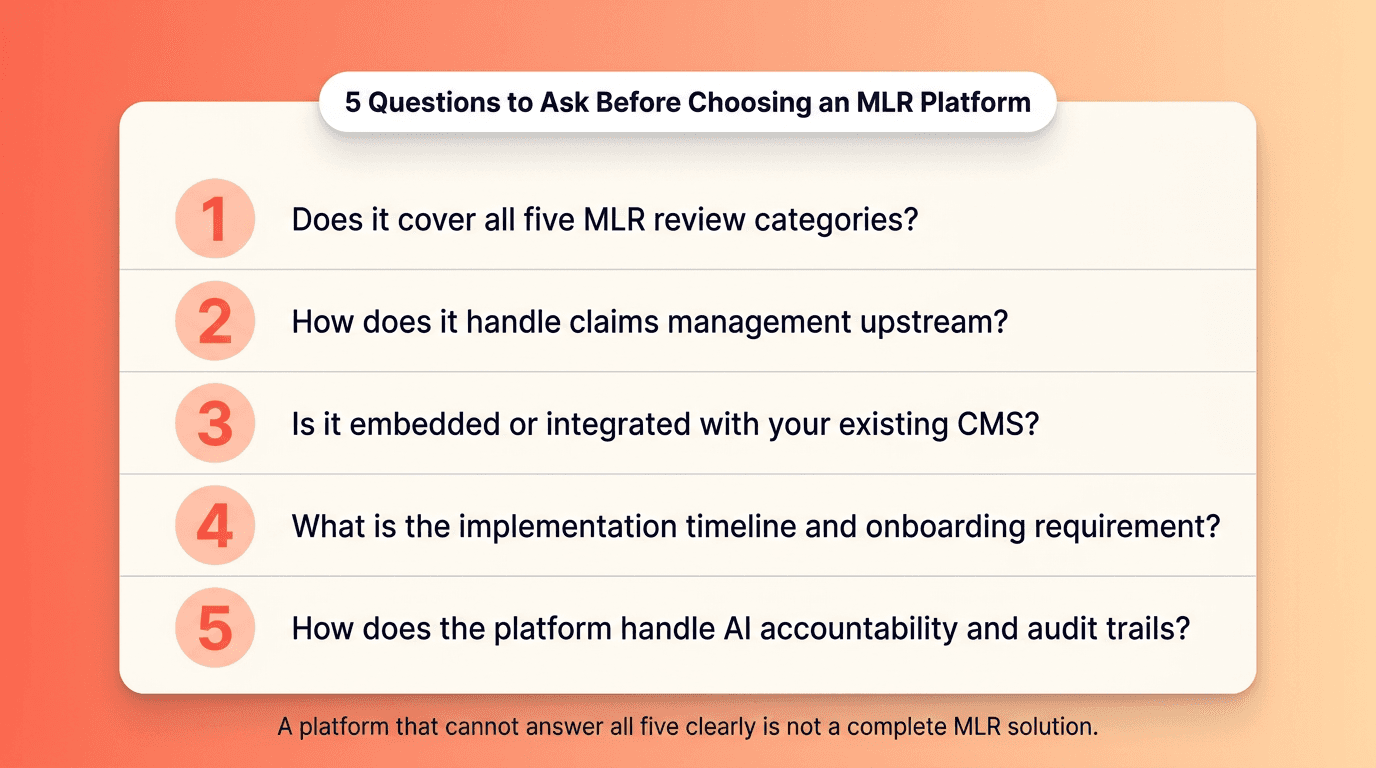
5 Questions to Ask When Evaluating MLR Content Software
Teams comparing platforms often focus on pricing, implementation timeline, and feature breadth. The more diagnostic questions go deeper into compliance architecture:
Does it cover all five MLR review categories? Regulatory compliance, claim substantiation, fair balance, editorial and brand guidelines, and market and channel compliance represent the full scope of what the FDA's OPDP evaluates. A platform that addresses three of the five creates structured gaps that still require manual reviewer coverage.
How does it handle claims management upstream? Errors and outdated language in the claims library are the primary source of downstream revision cycles. Ask whether the platform offers AI-powered claims extraction from approved materials and whether writers can access a validated claims library before entering formal review.
Is it embedded or integrated with your existing CMS? Either model works for regulated teams, but the right fit depends on the team's infrastructure. Embedded deployment surfaces AI compliance analysis directly inside the existing content management environment. Integrated deployment communicates bi-directionally with the CMS through APIs, allowing the AI tool to operate as a connected layer alongside the CMS, which remains the system of record. The wrong fit is a platform that does neither, since that leaves the CMS isolated from the AI compliance layer.
What does onboarding actually require from your team? Platforms that accept existing materials in their current state, with minimal data transformation or extensive customer list preparation, get reviewers working faster than platforms that require custom ingestion pipelines or workflow rebuilds upfront. For organizations managing active review queues, onboarding friction has compliance consequences beyond convenience, because the longer the rollout takes the longer compliance gaps go unaddressed.
How does the platform handle AI accountability and audit trails? Every compliance flag, reviewer action, and approval decision needs to be fully auditable. Ask whether the AI's analysis is logged alongside human decisions, and whether the audit trail meets the documentation standards your regulatory team requires.
FAQ
What is MLR content software, and how is it different from standard review tools?
MLR content software refers to AI review platforms purpose-built for pharmaceutical and life sciences promotional review. These platforms apply compliance intelligence to regulatory standards, claims substantiation, fair balance, and channel-specific rules, in addition to participating in standard file routing and approval workflows. Generic AI review tools and content management systems handle different parts of the review stack: a CMS manages the file infrastructure, and a generic AI review tool can run editorial-level checks. Specialized MLR review software adds the compliance evaluation layer that pharma promotional materials specifically require.
What are the five MLR review categories a pharma platform should cover?
A complete MLR platform should address regulatory compliance (FDA, EMA, and regional standards), claim substantiation (validation against approved claims and clinical data), fair balance (ensuring proper disclosure pairing with efficacy claims), editorial and brand guidelines (grammar, trademarks, consistency), and market and channel compliance (SOPs, channel rules, local market requirements). Coverage across all five is what differentiates comprehensive pharma marketing compliance software from platforms that address only a subset of MLR review categories.
How does AI work within an MLR review platform?
In a well-designed system, AI pre-screens content against compliance requirements and delivers structured findings to human reviewers before formal review begins. This means reviewers spend less time identifying obvious issues and more time evaluating judgment calls. The AI does not replace reviewer decisions. It surfaces risk, flags compliance gaps, and accelerates the analysis phase so that the human review is faster and more focused. This human-in-the-loop model is central to how AI is implemented in responsible pharma review environments.
Is it possible to embed MLR review software within an existing content management platform?
Yes. An embedded approach means AI-powered compliance analysis runs inside the existing content management environment without requiring teams to log into a separate platform. This reduces adoption friction significantly, particularly for large organizations where reviewer resistance to new tools is a known implementation risk. The embedded model is distinct from API-level integration, which still requires context-switching between interfaces.
What does onboarding for a purpose-built MLR platform usually involve?
Onboarding timelines vary based on team size, content volume, and how willing a platform is to accept existing materials in their current state. Platforms designed to work with existing file formats, claims libraries, and review workflows generally get teams to active use faster than platforms that require custom data ingestion, workflow reconfiguration, or extensive retraining before reviewers can begin working. For regulated teams, faster onboarding directly reduces the time review queues operate without AI-assisted compliance support.
Choosing Software That Matches the Compliance Requirement
The gap between generic AI review tools and purpose-built MLR review software is not primarily about features on a comparison table. It is about whether the AI layer was built around the compliance environment it is being asked to serve. Pharmaceutical promotional review requires domain-specific compliance intelligence at every stage: in the claims library that sits upstream of drafting, during AI-powered compliance screening, and throughout the reviewer workflow. AI tools that address only one or two of those layers leave regulated teams carrying compliance risk manually.
For teams evaluating promotional review software, the most useful diagnostic is not whether a tool can run editorial checks or generate basic audit logs. The diagnostic is whether the AI layer can evaluate a piece of promotional content across all five MLR categories and surface findings in the context where reviewers are already working.
Revisto is AI-powered pharma marketing compliance software built specifically for life sciences teams. With specialized AI agents covering all five MLR review categories and flexible deployment options, Revisto Studio for teams that want a dedicated AI workspace and Revisto Companion for teams already operating inside an existing CMS, Revisto is designed to meet regulated teams where they already work. Request a demo to see how the platform handles your review environment.