
Key TakeawaysThe regulatory reviewer is the compliance backbone of the MLR process pharma teams depend on to protect both patients and brand integrity.
As content volume grows and FDA scrutiny increases, the case for giving regulatory reviewers better-prepared content and smarter screening support keeps strengthening. |
|---|
Every promotional material that reaches a physician, patient, or caregiver has cleared a rigorous internal review governed by the medical legal regulatory review process. Within that process, one role carries the specific mandate of regulatory compliance: the regulatory reviewer. Their job is to ensure that every claim, every risk disclosure, and every visual element in a promotional piece aligns with FDA regulations, approved labeling, and applicable market requirements. Understanding what that role actually entails, and where it creates bottlenecks, is essential for any team responsible for the MLR process pharma organizations rely on to protect patients and bring compliant marketing to market.
Regulatory reviewers sit at the intersection of science, law, and commercial strategy. They are not simply checking boxes against a static checklist. They are interpreting guidance that evolves continuously, applying it to content produced across an expanding range of channels, and making judgment calls under significant time pressure.
Getting it wrong carries real consequences: in September 2025, the FDA issued more than 100 enforcement letters targeting prescription drug promotional materials in a single month, a level of enforcement activity that had no recent precedent. For every regulatory reviewer MLR teams are relying on, that enforcement climate adds urgency to a workload that was already demanding.
This guide breaks down the regulatory reviewer's responsibilities in detail, examines the labeling requirements and risk signals they monitor most closely, and explores how specialized AI tools are changing the work, without removing the human judgment that makes MLR compliance defensible.
What Does a Regulatory Reviewer Do in the MLR Process Pharma Teams Use?
The regulatory reviewer's primary function is to evaluate promotional materials against the full body of applicable regulations and internal policy before those materials reach any external audience. That scope is broader than it sounds, and the stakes are high enough that a single oversight can trigger an enforcement letter, a product recall of promotional materials, or reputational damage that lingers well beyond the original violation.
Core Regulatory Compliance Responsibilities
At the center of the regulatory reviewer's role is alignment with 21 CFR Part 202, the federal code governing prescription drug advertising. This regulation establishes what must be disclosed, how risk information must be presented, and what constitutes a false or misleading claim. Regulatory reviewers check promotional content against this framework in every review cycle.
Beyond the base regulation, reviewers must also apply FDA guidance documents, which are updated frequently and do not always arrive with clear implementation timelines. Agency guidance on topics like social media promotion, character-space limitations, and the use of artificial intelligence in advertising has continued to evolve, and staying current requires active monitoring rather than periodic review.
The regulatory reviewer is typically the person within the promotional review committee responsible for tracking and translating these updates for the broader team. In that capacity, they serve as the primary interpreter of pharmaceutical advertising regulations for the entire MLR team.
Labeling Alignment and Off-Label Risk
One of the most consequential checks a regulatory reviewer performs is confirming that every promotional claim traces back to the approved product labeling, specifically the Prescribing Information (PI). Any claim that extends beyond what the PI supports, even implicitly, carries off-label risk. The FDA has consistently targeted off-label promotion in its enforcement activity, and in its 2025 enforcement surge, exaggerated efficacy claims relative to approved indications were among the most commonly cited violations.
Labeling alignment is not only about claim accuracy. It also governs how product names are displayed, the prominence of the established name relative to the proprietary name, and the order and completeness of risk disclosures. For biological products and biosimilars, additional labeling requirements apply, including accurate representation of approved indications and routes of administration. Regulatory reviewers must hold all of this context simultaneously when evaluating a single piece of promotional content.
Review Category | What the Regulatory Reviewer Evaluates |
|---|---|
Labeling alignment | All claims traceable to approved PI; no off-label implication |
Fair balance | Risk information prominent, complete, and not minimized relative to efficacy |
21 CFR Part 202 | Disclosure format, brief summary requirements, ad structure |
Market/channel compliance | Channel-specific rules, jurisdiction requirements, DTC vs. HCP standards |
Evolving FDA guidance | Social media, AI-generated content, new product class rules |

Why Is Fair Balance One of the Hardest Parts of the Medical Legal Regulatory Review Process?
Fair balance is both a regulatory requirement and a judgment call. Under 21 CFR Part 202, promotional materials must present risk information with prominence and readability comparable to efficacy claims. The regulation specifies that an advertisement is not lacking in fair balance solely because it presents risk information in a different format than efficacy information, but the overall impression of the piece must not suggest that a drug is safer or more effective than its labeling indicates.
In practice, this requires the regulatory reviewer to evaluate more than just the presence of a risk disclosure. They must assess font size and placement relative to efficacy claims, whether audio risk disclosures in broadcast ads are delivered at the same pace as benefit claims, and whether visual elements like photography or graphics create an impression of safety that the text does not support. The FDA's 2024 final rule on DTC television and radio advertising, which took effect in November 2024, codified requirements that the major statement be presented clearly, conspicuously, and in a neutral manner, including standards for audio presentation that were not previously specified in regulation.
How Fair Balance Failures Surface in Enforcement
OPDP's enforcement letters consistently identify fair balance failures as a primary violation. A Latham & Watkins client alert from September 2025 analyzing FDA's enforcement surge noted that omitting or minimizing risk information remains the most obvious enforcement target for the agency, and that letters frequently cited materials where appealing visuals or celebrity endorsements presented efficacy in an engaging format while risk information was delivered in a way that was materially less prominent.
When a piece presents "improves outcomes" prominently in headline text while burying contraindications in a footnote, that imbalance creates regulatory exposure regardless of technical compliance with any individual checklist item. The regulatory reviewer must assess the piece holistically, not just element by element. This is the dimension of the role where experienced judgment has the most impact on compliance outcomes.
How Does the Regulatory Reviewer Fit Into the Broader MLR Compliance Framework?
The medical legal regulatory review process involves three distinct reviewer roles, each evaluating a different dimension of promotional content. Medical reviewers validate scientific accuracy and claims substantiation against clinical evidence. Legal reviewers assess litigation risk, intellectual property considerations, and applicable laws. Regulatory reviewers handle the compliance layer: pharmaceutical advertising regulations, approved labeling, market-specific requirements, and evolving FDA guidance.
These three functions operate in parallel in a well-structured promotional review committee, but they interact constantly. A claim that is scientifically accurate may still create labeling misalignment. A legally defensible assertion may still violate pharmaceutical advertising regulations if it implies an off-label use. The regulatory reviewer serves as the checkpoint where these overlaps get resolved before any material goes external.
The Role of Content Management Platforms in MLR Workflow
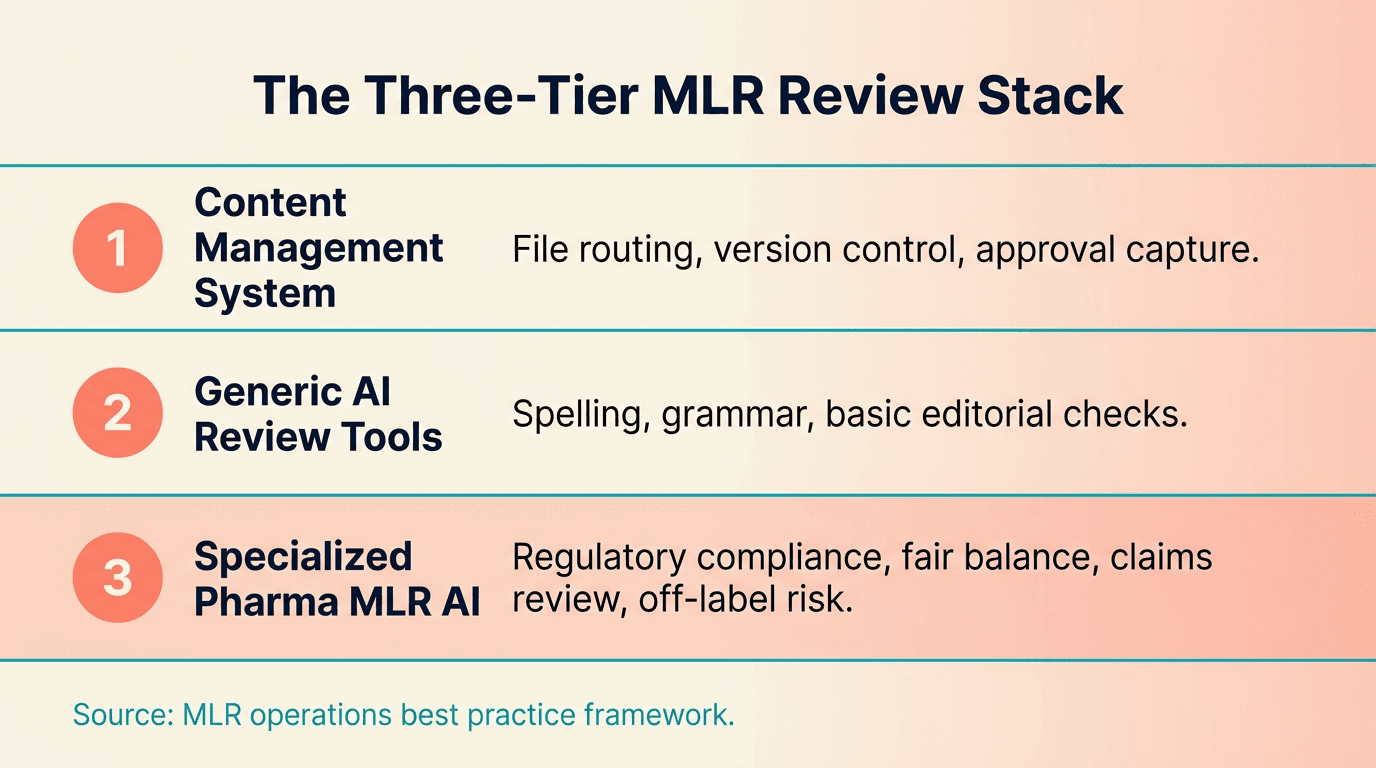
The MLR process pharma companies run typically sits within a content management system that handles file routing, version control, and approval capture. These platforms are the system of record for the review workflow, but they do not perform compliance evaluation. They store and route documents; they do not assess whether a fair balance disclosure is adequate or whether a claim aligns with the PI. That distinction matters when teams are evaluating what tooling can actually reduce regulatory risk versus what tooling manages process logistics.
The compliance evaluation layer, where the regulatory reviewer works, is separate from the file management layer. Specialized pharma MLR AI review software operates in this compliance evaluation space, screening for regulatory violations before human reviewers pick up a piece.
General-purpose AI tools, by contrast, may flag grammar or formatting issues but lack the pharma-specific compliance intelligence needed for MLR review. Understanding this three-tier structure, content management, generic AI, and specialized pharma MLR AI, helps teams identify where the real review bottlenecks actually live.
Tool Tier | Function | What It Does Not Do |
|---|---|---|
Content management system | File routing, version control, approval capture, audit trail | Evaluate compliance; screen claims against labeling |
Generic AI review tools | Spelling, grammar, basic editorial checks | MLR-specific compliance evaluation; pharma regulatory screening |
Specialized pharma MLR AI | Regulatory compliance screening, fair balance checks, claims review, off-label risk flagging | Replace human regulatory judgment on nuanced risk calls |
Regulatory reviewers benefit most from the third tier, tools purpose-built to surface compliance gaps before the human review stage, reducing the volume of routine screening work and allowing reviewers to concentrate on the judgment calls that matter. Teams exploring this category can find more context on how embedded AI review tools work alongside existing CMS workflows at the embedded MLR review product page.
5 Risk Signals the Regulatory Reviewer Monitors in Every MLR Review
These are the compliance gaps most likely to draw OPDP scrutiny, based on enforcement patterns from 2024 and 2025.
Off-label implication in efficacy claims. Any language suggesting effectiveness for an indication not included in the approved PI is an immediate flag. This includes indirect implication through patient population language or mechanism-of-action framing that extends beyond the approved indication.
Fair balance prominence failures. Risk disclosures that are present but not given comparable visual or audio prominence to efficacy claims violate both the spirit and letter of pharmaceutical advertising regulations under 21 CFR Part 202. The 2024 DTC final rule raised the bar for audio disclosure standards specifically.
Unsubstantiated efficacy claims. Claims that go beyond what clinical trial data in the PI can support, even if supported by external literature, require careful review. OPDP's 2025 enforcement letters cited health-related quality of life claims as a specific area of concern when those claims lacked PI-level substantiation.
Channel-specific format violations. Different content formats carry different requirements. Social media posts, banner ads, broadcast spots, and HCP detail aids each have distinct disclosure and format obligations. The regulatory reviewer must evaluate each piece against the rules applicable to its specific delivery channel.
Modular content assembly gaps. As pharma teams increasingly use pre-approved modular content blocks assembled into new promotional pieces, regulatory reviewers must confirm that the assembled combinations remain compliant as a whole. An approved module may create labeling misalignment when combined with content from a different indication or therapeutic area.

How Is AI Changing the Regulatory Reviewer's Work in the MLR Process?
AI-assisted review is not displacing the regulatory reviewer. It is changing what the regulatory reviewer spends time on. Routine screening tasks that previously required a reviewer to manually check each claim against the PI line by line can now be handled by purpose-built compliance AI before the document reaches the human review queue. That shift does not eliminate the role; it compresses the time spent on lower-judgment tasks and surfaces the issues that actually require expertise. For the regulatory reviewer MLR operations teams are increasingly asking to do more with the same resources, that shift matters.
What AI Handles in Regulatory Screening
Specialized pharma marketing compliance software can screen promotional content for regulatory violations across multiple categories simultaneously: labeling alignment, fair balance assessment, off-label risk signals, and channel-specific format requirements. It can also monitor regulatory guidance updates and flag which approved materials may be affected by a change in agency position, a task that previously required manual tracking. For teams managing omnichannel pharma marketing campaigns across multiple assets and channels, this screening layer significantly reduces the probability that a violation reaches the human review stage.
AI also plays a specific role in supporting the claims library: extracting approved language from existing materials, organizing it for searchable reference, and keeping it current as the PI evolves. Writers and content teams can draw from a validated claims library to build new promotional materials, reducing the probability that unapproved language enters the review pipeline. Teams looking for a deeper technical overview can find one in this breakdown of AI technologies in pharma MLR.
What Stays Human
The judgment calls that require contextual understanding of the full regulatory environment and the specific risk profile of a product remain with the regulatory reviewer. Interpreting a novel application of FDA guidance to a new content format, evaluating whether a combination of approved modular elements creates an emergent compliance risk, and making the call on borderline fair balance cases are decisions that require expertise and accountability that AI tools do not necessarily provide. The human-in-the-loop structure of the medical legal regulatory review process is not a limitation to be designed around. It is a feature that keeps the compliance framework defensible under scrutiny.
Frequently Asked Questions
What is the difference between a regulatory reviewer and a medical reviewer in the MLR process?
Medical reviewers evaluate the scientific and clinical accuracy of promotional claims, confirming that content is grounded in valid clinical evidence and consistent with the product's data package. Regulatory reviewers evaluate compliance with FDA regulations, approved labeling, and applicable market requirements. The two roles often interact: a medically accurate claim may still create a regulatory violation if it extends beyond approved labeling or is presented without adequate fair balance. Both reviewers operate within the same promotional review committee but evaluate different dimensions of the same content.
What regulations does a regulatory reviewer check against in pharma MLR compliance?
The primary regulatory framework for prescription drug advertising in the US is 21 CFR Part 202, which governs what must be disclosed, how risk information must be presented relative to efficacy claims, and what constitutes a false or misleading promotion. Regulatory reviewers also apply FDA guidance documents on specific topics, including social media promotion, DTC advertising standards, and biosimilar labeling. MLR compliance in international markets requires additional frameworks, including EMA guidelines in Europe and MHRA requirements in the UK, making global pharma operations among the most complex regulatory reviewer MLR environments to manage.
Why did FDA enforcement of pharmaceutical advertising regulations increase in 2025?
In September 2025, the FDA issued more than 100 enforcement letters in response to a presidential directive to enforce prescription drug advertising provisions and address misleading DTC advertising. The agency announced it used AI tools to proactively monitor promotional content at scale, enabling a volume of enforcement activity that would not have been possible through traditional review processes alone. The most commonly cited violations were exaggerated efficacy claims, fair balance failures in DTC video advertising, and content that implied benefits beyond approved indications.
What is fair balance in pharma MLR, and why does it matter?
Fair balance is the requirement that promotional materials present risk information with prominence and readability comparable to efficacy claims. Under 21 CFR Part 202, an advertisement cannot suggest that a drug is safer or more effective than its labeling indicates, and risk disclosures must be presented in a way that gives them comparable weight to benefit claims. Failures in fair balance are among the most common triggers for OPDP enforcement letters. The FDA's November 2024 final rule added specific audio standards for DTC television and radio advertising, requiring that the major statement on side effects be delivered clearly and conspicuously.
How does AI support the MLR process pharma teams run without replacing reviewers?
Purpose-built pharma MLR AI screens content for compliance issues, labeling gaps, fair balance problems, and off-label risk signals before materials reach the human review queue. This reduces the volume of routine checks reviewers handle manually and surfaces the issues that require expert judgment. Human reviewers retain responsibility for all final compliance determinations, including borderline fair balance calls, novel applications of evolving guidance, and any risk assessment that requires context an AI tool cannot evaluate on its own.
Supporting Regulatory Reviewers with the Right Tools
The regulatory reviewer's role in the MLR process pharma teams run has always been demanding. The body of regulations they must track is large and continues to grow. The content volume they must process keeps increasing. And the enforcement environment, as 2025 made clear, can intensify faster than teams anticipate.
Building the operational infrastructure to support that role, specifically by reducing the time regulatory reviewers spend on routine compliance screening and giving them cleaner, better-prepared content to evaluate, has a direct impact on both cycle time and MLR compliance outcomes.
Revisto is built to work alongside regulatory reviewers, handling the systematic compliance screening that precedes human judgment. Revisto's AI MLR Engine covers all five review categories, including regulatory compliance, fair balance, and claims substantiation, and integrates directly with existing content management workflows so reviewers work in the environment they already use. To see how specialized pharma MLR AI support can reduce rework and strengthen your team's review capacity, request a demo with the Revisto team.