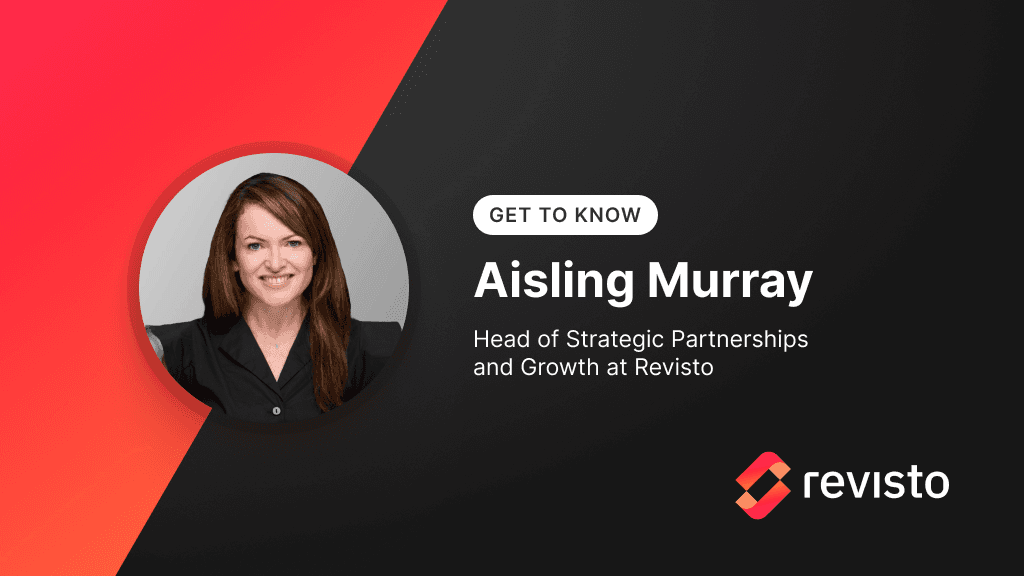
Behind every great solution is a team that truly understands the problem it's solving. In our ongoing spotlight series, we're introducing the people at Revisto who've spent their careers at the intersection of pharma, compliance, and commercial strategy — and who are now helping reshape how MLR works.
We sat down with Aisling Murray, Revisto's Head of Strategic Partnerships & Growth, to talk about what she's learned from the industry, how AI is changing her day-to-day, and why she sees content review as a big strategic lever for pharma.
1. Where are you based?
I'm based in Zurich, Switzerland, though my work is very global. I've spent most of my career working across the US and Europe, and having lived in a few countries, I tend to think about challenges through an international lens.
2. What's your role at Revisto?
I lead commercial strategy and partnerships, focused on helping pharma companies rethink how they approach MLR and content review.
A big part of my role is connecting Revisto's capabilities to real-world challenges by working closely with customers to drive adoption, build long-term partnerships, and ultimately deliver measurable impact.
3. How do you use AI in your day-to-day work?
I've always tried to leverage technology in my day-to-day work, so AI has really helped me work faster and more efficiently. Like most people, I started with tools like ChatGPT to structure thinking, pressure-test ideas, and refine messaging. Then I moved on to leveraging Gemini and Claude, especially co-work to work faster and more efficiently.
More broadly, I'm very interested in how AI can move beyond productivity gains and start solving more complex, cross-functional challenges, particularly in areas like MLR, where workflows are fragmented and difficult to scale.
4. When you were a kid, what did you want to be when you grew up?
It changed over time, but funny enough looking back always had a common theme.
When I was a kid, I wanted to be a flight attendant (mainly driven by a love of travel and curiosity about the world). Then later, I wanted to be an FBI agent, which I think says something about being drawn to problem-solving and figuring things out.
In a way, my career has ended up being a mix of both, global exposure and solving complex challenges, just in a slightly different context.
5. What impact do you think Revisto is making in the MLR and promotional review space?
MLR has traditionally been seen as a necessary bottleneck: slow, resource-intensive, and difficult to scale.
What Revisto is doing is fundamentally shifting that perception. By using AI to drive consistency, reduce cycle times, and support better decision-making, we're helping transform MLR into something that can enable the business to move faster, rather than slow it down.
That's a meaningful shift, especially as content volume continues to increase with increases in digital tools and media.
6. What drew you to this role at Revisto?
Having spent years working on both the pharma and agency sides of the business, I've seen firsthand how much friction exists in the MLR/PRC content review process. It's one of those challenges everyone recognizes but historically hasn't been easy to solve.
I had worked with the CEO & Co-Founder Ferry Tamtoro at his previous startup, so I was excited to hear that he was trying to tackle this problem. I had seen Ferry's ability to build and scale in the pharma space firsthand. That combination, strong leadership and a clear, high-impact problem to solve, made it an easy decision.
7. Given your history in the pharma commercialization space, what do you think has changed, and what hasn't?
What's changed is the expectation around speed, personalization, and data-driven engagement. Pharma is moving closer to the standards we see in other industries.
What hasn't changed is the underlying complexity: the regulatory requirements, risk sensitivity, and the number of stakeholders involved. The challenge now is how to operate with greater agility without compromising on those fundamentals.
8. What needs to change for pharma to truly deliver on personalized, digital engagement?
One of the biggest areas for disruption is digital content and engagement. Across the companies I've worked with, there's a clear ambition to deliver more personalized, timely, data-driven communication to HCPs and patients — but execution is still heavily constrained by the content review process. Strong strategy and high-quality content pipelines mean little if materials can't get approved fast enough to deliver on that vision.
What's changing now is the emergence of AI agents that can dynamically generate and personalize content at scale. The challenge is that the MLR/PRC model hasn't evolved at the same pace, and that creates real tension.
Companies that treat MLR as a strategic capability, and evolve it to support AI-driven, personalized content, will unlock a significant competitive advantage. Those that don't risk being constrained by their own processes. It's not just about efficiency; it's about whether organizations can deliver on the promise of personalization in a compliant, scalable way.